

Discover the Imperial World of the Ottoman Sultans
For nearly four centuries, Topkapi Palace stood at the heart of the Ottoman Empire, serving as the principal residence of the sultans and one of the most important centers of imperial government. Commanding a spectacular position overlooking the Bosphorus, Golden Horn, and Sea of Marmara, the palace was not simply a royal residence. It was an immense imperial complex where sultans lived, state affairs were conducted, foreign ambassadors were received, princes were educated, treasures were guarded, and generations of the Ottoman dynasty shaped the history of an empire stretching across three continents.
Construction of the palace began during the reign of Sultan Mehmed II — Mehmed the Conqueror — following the Ottoman conquest of Constantinople in 1453. Rather than creating a single monumental palace building, the Ottomans developed a vast complex of courtyards, gardens, ceremonial gates, pavilions, council chambers, kitchens, treasuries, and private apartments. Successive sultans expanded and transformed the palace over the centuries, leaving behind an extraordinary architectural record of Ottoman court life.
At the most private heart of this imperial world was the Harem, home to the Sultan’s family and a highly organized household governed by its own hierarchy, traditions, and ceremonial life. Together, the palace courtyards and Harem offer one of the most fascinating opportunities in Istanbul to understand how the Ottoman dynasty actually lived and how one of history’s most powerful empires was governed.
Why Is Topkapi Palace So Important?
Topkapi Palace was far more than the home of the Ottoman sultans. For centuries, it functioned as the political, administrative, educational, ceremonial, and dynastic center of the Ottoman Empire.
From within its walls, decisions were made that affected territories extending across southeastern Europe, the Middle East, North Africa, and the eastern Mediterranean. Members of the Imperial Council discussed affairs of state, foreign ambassadors were received according to elaborate court protocols, and young men selected for imperial service were educated within the palace before entering some of the highest positions of Ottoman government.
At the same time, Topkapi was a private royal residence. Beyond its increasingly restricted gates and courtyards lay the Sultan’s apartments, the Imperial Harem, secluded gardens, libraries, pavilions, and terraces overlooking the waters surrounding Istanbul.
This combination of government and private life, ceremony and seclusion, extraordinary wealth and strict hierarchy is what makes Topkapi Palace so different from many European royal palaces.
Mehmed the Conqueror and the Creation of Topkapi Palace
After conquering Constantinople in 1453, Sultan Mehmed II began transforming the former Byzantine capital into the center of the Ottoman Empire. Among his most important projects was the creation of a new imperial palace on the historic peninsula, occupying one of the most strategically and visually impressive locations in the city.
Construction began in the years following the conquest, and the palace developed into the principal seat of Ottoman power. Originally known as the New Palace (Saray-i Cedid), it would only much later become widely known as Topkapi Palace.
Its design differed significantly from the concept of a single enormous royal residence. Instead, the palace developed as a series of interconnected spaces arranged around successive courtyards. As visitors moved deeper into the complex, access became increasingly restricted.
This arrangement reflected the hierarchy of the Ottoman court itself: from the relatively accessible outer areas of the palace to the administrative center of government, and finally to the highly restricted private world of the Sultan and his household.
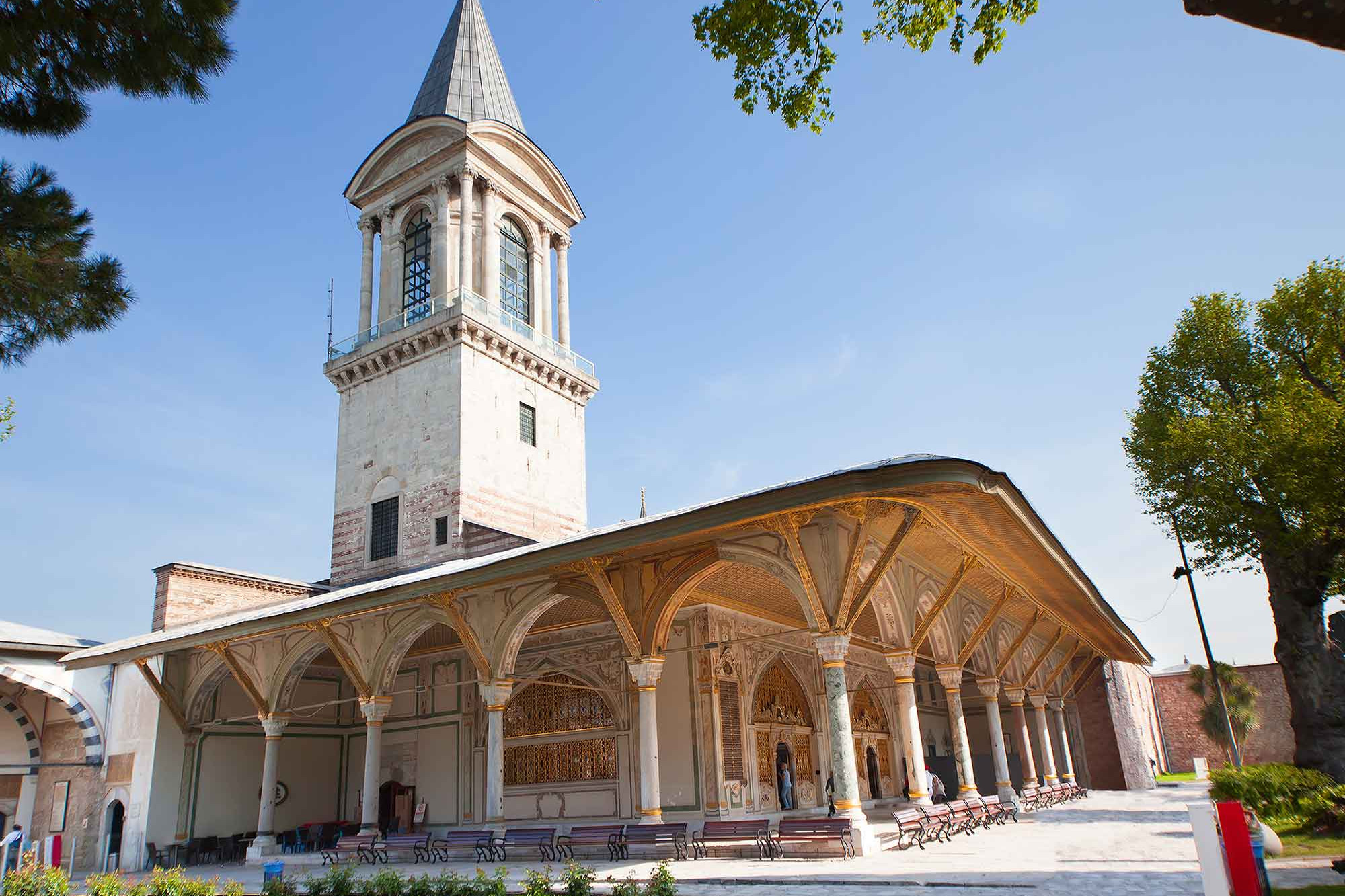
The Four Courtyards of Topkapi Palace
Understanding the four courtyards is one of the best ways to understand Topkapi Palace.
Rather than wandering through a collection of unrelated buildings, visitors are essentially following a progression from the public world toward the private world of Ottoman imperial power.
The First Courtyard: The Outer Palace
Entered through the monumental Imperial Gate, the First Courtyard formed the outermost and most accessible area of Topkapi Palace.
Unlike the increasingly restricted courtyards beyond it, this area accommodated people and activities connected with the wider operation of the imperial complex. It served as a transitional space between the city and the palace itself.
One of its most important surviving monuments is Hagia Irene, a Byzantine church that predates the Ottoman palace. Its survival within the palace grounds provides a remarkable reminder that Topkapi was constructed within the historic landscape of Byzantine Constantinople.
The Second Courtyard: The Administrative Heart of the Empire
Passing through the imposing Gate of Salutation brings visitors into the Second Courtyard, where the administrative machinery of the Ottoman Empire becomes much more visible.
Here stood the Imperial Council Chamber (Divan-i Humayun), where the empire’s senior officials met to discuss political, military, legal, and administrative affairs. Although the Sultan did not ordinarily preside directly over these meetings, he could observe proceedings from behind a screened window above the council chamber.
The Second Courtyard also contains the enormous Imperial Kitchens, which once prepared food for thousands of palace residents, officials, servants, and guests. Today, the buildings house important parts of the palace collections and help reveal the extraordinary scale of daily life within the Ottoman court.
The entrance to the Imperial Harem is also reached from this part of the palace, marking the transition from the administrative world of government toward the private world of the dynasty.
The Third Courtyard: The Sultan’s Inner Palace
Beyond the Gate of Felicity lay the Third Courtyard, known as the inner palace and accessible only to those permitted to enter the Sultan’s more private domain.
Immediately beyond the gate stands the Audience Chamber, where the Sultan formally received senior officials and foreign ambassadors. The carefully controlled setting emphasized the distance, ceremony, and authority surrounding the Ottoman ruler.
The courtyard was also associated with the Enderun Palace School, where selected young men received an elite education preparing them for service within the Ottoman administration.
Today, this area contains some of Topkapi Palace’s most celebrated collections, including the Imperial Treasury and the Sacred Relics.
The Fourth Courtyard: Pavilions, Gardens and Imperial Views
The Fourth Courtyard reveals a very different side of Topkapi Palace.
Rather than administrative chambers and ceremonial gates, visitors encounter landscaped terraces, gardens, fountains, and elegant imperial pavilions overlooking the Bosphorus and Golden Horn.
Structures such as the Baghdad Pavilion and other royal kiosks provided the Sultan with more intimate spaces for relaxation, receptions, and contemplation away from the formal environment of the palace’s administrative courtyards.
From these terraces, it becomes easy to understand why Mehmed II chose this extraordinary location for his imperial residence.
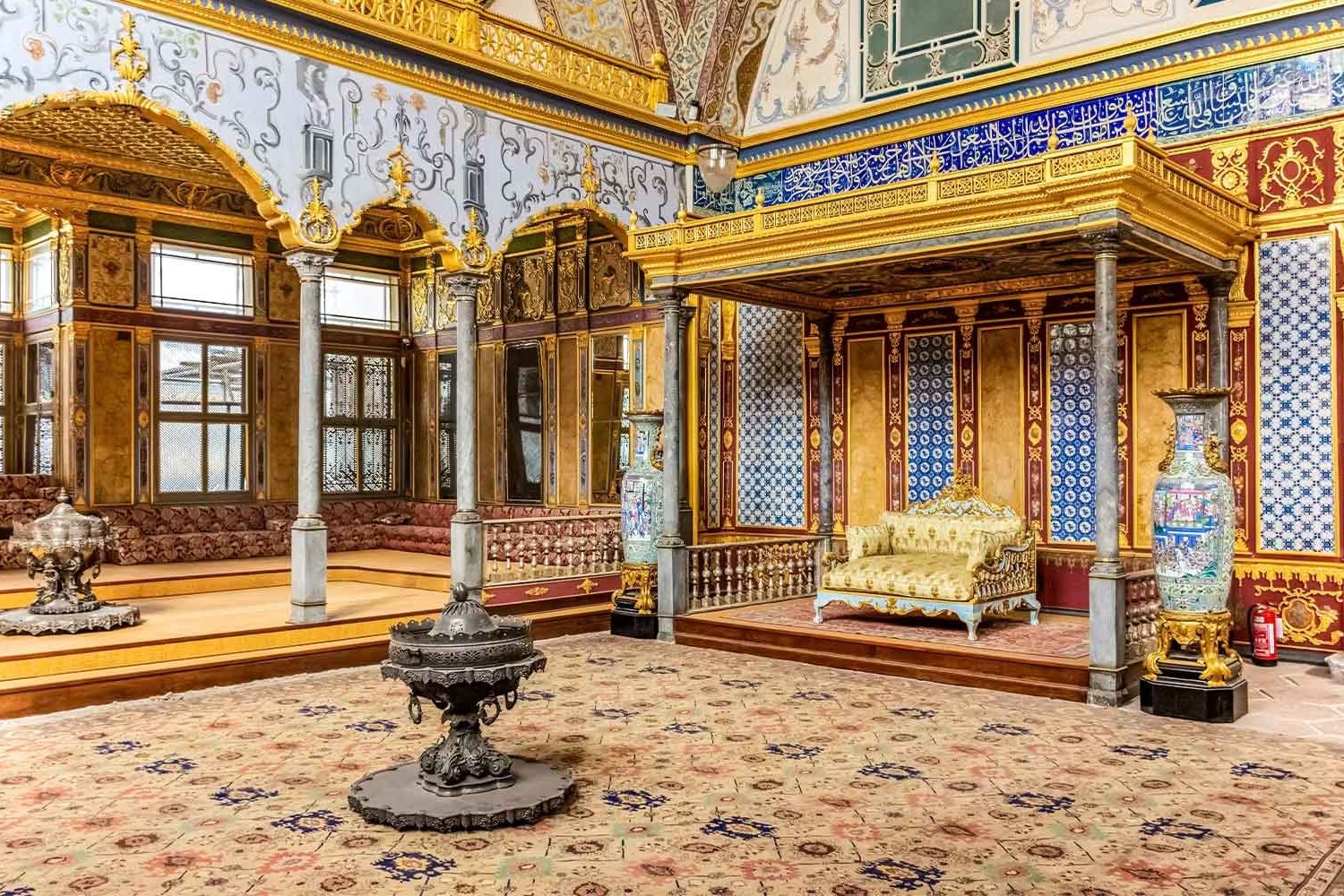
Inside the Imperial Harem
Few parts of Topkapi Palace have inspired as much curiosity as the Imperial Harem. Often misunderstood through romanticized Western accounts, the Harem was not simply a secluded residence for the Sultan’s women. It was the private household of the Ottoman dynasty — a highly organized world inhabited by the Sultan, his mother, consorts, children, princes, female attendants, and eunuchs who served and administered the household.
The word harem derives from an Arabic root associated with something sacred, protected, or forbidden. Within the Ottoman palace, it referred to the private quarters of the imperial family, carefully separated from the more public and administrative areas of court life.
The Harem visible today developed over generations, particularly from the 16th century onward. Its interconnected rooms, corridors, courtyards, baths, ceremonial halls, and private apartments provide a fascinating glimpse into both the daily life and the complex hierarchy of the Ottoman dynasty.
The Valide Sultan: The Sultan’s Mother
Among the most powerful figures within the Harem was the Valide Sultan, the mother of the reigning Sultan.
Her position placed her at the head of the female hierarchy of the imperial household. She supervised important aspects of life within the Harem, maintained her own household and apartments, and could exercise considerable influence through her relationship with the Sultan.
The political influence of imperial women became particularly visible during the period often called the Sultanate of Women, when several royal mothers and consorts played important roles in dynastic and political affairs.
Walking through the apartments associated with the Valide Sultan therefore reveals something often overlooked in simplified accounts of Ottoman history: the Harem could also be an important environment of dynastic influence and court politics.
Consorts, Children and Life in the Harem
The Harem was home to women occupying different positions within a carefully structured hierarchy. Some entered palace service and received education and training, while a smaller number became consorts of the Sultan and mothers of imperial children.
Life within the Harem was governed by strict rules of rank, protocol, education, and service. Women could be trained in subjects such as court etiquette, religion, music, embroidery, and other skills considered appropriate within palace society.
The Harem was also home to the Sultan’s daughters and, during important periods of Ottoman history, the young imperial princes whose succession could determine the future of the empire.
It was therefore simultaneously a family residence, educational environment, dynastic institution, and carefully regulated court society.
The Harem Eunuchs
Access to the private quarters of the imperial family was carefully controlled. An important role in the administration and security of the Harem was performed by eunuchs, particularly the Black Eunuchs serving under the Chief Harem Eunuch.
The Chief Harem Eunuch became one of the most important officials within the Ottoman palace. His position gave him direct access to the Sultan and imperial family and placed him within networks connecting the palace with important religious and charitable institutions elsewhere in the empire.
Their quarters near the entrance of the Harem demonstrate the importance of controlling movement between the administrative palace and the private household beyond.
The Apartments of the Valide Sultan
Among the most impressive spaces within the Harem are the apartments associated with the Valide Sultan.
Decorated with tiles, painted surfaces, fireplaces, and elaborate architectural details, these rooms reflected her exceptional position within the imperial household. Their location also demonstrates the hierarchy that shaped the organization of the Harem itself.
Rather than functioning as an arbitrary maze of rooms, the Harem was carefully organized according to rank, access, privacy, and proximity to the Sultan.
The Imperial Hall
One of the grandest spaces within the Harem is the Imperial Hall, also known as the Sultan’s Hall.
With its high dome, elaborate decoration, Iznik tiles, and ceremonial character, the hall was used for gatherings and important occasions involving members of the imperial household.
Its scale contrasts dramatically with the narrow corridors and smaller private rooms encountered elsewhere in the Harem and provides a vivid reminder that this was not simply a residential area but part of the ceremonial world of the Ottoman dynasty.
The Sultan’s Private Apartments
The Harem also contains private chambers associated with different Ottoman sultans. As successive rulers renovated and expanded the complex, architectural and decorative styles changed, leaving behind rooms representing different periods of Ottoman palace art.
Some of the most beautiful interiors demonstrate the extraordinary craftsmanship for which the Ottoman court became famous: Iznik tiles, mother-of-pearl inlay, calligraphy, stained glass, carved woodwork, fountains, and painted decoration.
These rooms make the Harem particularly valuable for understanding how Ottoman palace architecture evolved over several centuries.
The Apartments of the Princes
The apartments associated with the Ottoman princes offer another fascinating glimpse into dynastic life.
The lives of imperial princes were inseparable from the question of succession to the throne. Ottoman succession practices changed considerably over the centuries, and princes could find themselves at the center of intense political uncertainty.
The beautiful rooms associated with the princes therefore carry a striking contrast: their elegant decoration reflects imperial privilege, while their history recalls the complicated realities of succession, confinement, and dynastic survival within the Ottoman court.
Power and Politics Inside the Harem
The Harem should not be understood as a separate world completely disconnected from Ottoman government.
Although formal affairs of state were conducted elsewhere in the palace, relationships within the imperial household could have significant political consequences. The Sultan’s mother, consorts, daughters, princes, eunuchs, and senior palace officials all belonged to interconnected networks of patronage and influence.
Marriage alliances, royal births, succession, education, charitable foundations, appointments, and access to the Sultan could all carry political significance.
Understanding the Harem in this way transforms a visit from simply walking through beautiful rooms into an exploration of family, hierarchy, politics, education, and dynastic power at the heart of the Ottoman Empire.

Treasures of Topkapi Palace
Beyond its architecture and imperial apartments, Topkapi Palace preserves extraordinary collections accumulated during centuries of Ottoman rule. Ceremonial objects, jewels, weapons, manuscripts, religious relics, imperial clothing, and diplomatic gifts provide another perspective on the wealth and global connections of the Ottoman court.
The Imperial Treasury
The Imperial Treasury contains some of the most famous objects associated with the Ottoman dynasty.
Unlike a modern collection assembled simply for display, many of these objects belonged to the ceremonial and political world of the palace. Precious stones, gold, emeralds, diamonds, weapons, thrones, decorative objects, and diplomatic gifts communicated the wealth and prestige of the Ottoman court.
Two objects in particular have become synonymous with Topkapi Palace.
The Topkapi Dagger
The spectacular Topkapi Dagger is one of the palace’s most recognizable treasures. Created in the 18th century, it is decorated with large emeralds and elaborate gold work.
The dagger was originally intended as a diplomatic gift for the Persian ruler Nader Shah. However, news of his assassination reached the Ottoman delegation before the gift could be presented, and the dagger eventually returned to the imperial treasury.
Its fame grew considerably in the modern era after inspiring the jewel theft at the center of the 1964 film Topkapi.
The Spoonmaker’s Diamond
Another celebrated treasure is the Spoonmaker’s Diamond, an extraordinary pear-shaped diamond surrounded by smaller stones.
The exact history of the diamond is surrounded by competing stories and legends, including the famous tale from which its popular name is derived. Rather than presenting one of these stories as established fact, it is better to appreciate the diamond as one of the most remarkable surviving jewels of the Ottoman treasury.
The Sacred Relics
One of the most important collections within Topkapi Palace is the Sacred Relics associated with the Islamic tradition.
The collection includes objects traditionally connected with the Prophet Muhammad and other important figures in Islamic and biblical tradition. Many of these relics entered Ottoman possession following the empire’s expansion into the Arab lands during the early 16th century.
For the Ottoman sultans, their significance extended far beyond their material value. They contributed to the palace’s religious prestige and to the Ottoman dynasty’s presentation of itself as a protector of Islam’s holy places and traditions.
The Imperial Kitchens and Porcelain Collection
The enormous Palace Kitchens reveal another side of life at Topkapi.
Food had to be prepared every day for a vast palace community, requiring a sophisticated organization of cooks, specialists, storerooms, and kitchens. The surviving complex helps visitors appreciate the enormous scale of the imperial household.
The palace is also renowned for its collection of Chinese and Japanese porcelain, reflecting centuries of diplomacy, trade, collecting, and the Ottoman court’s connections with the wider world.
Visiting Topkapi Palace & Harem Today
Topkapi Palace remains one of Istanbul’s most important historic monuments and one of the most extensive sites to visit in the Old City. Unlike a single museum building, the palace is a large complex of courtyards, pavilions, exhibition rooms, gardens, treasuries, and private apartments, so allowing sufficient time makes a considerable difference to the experience.
The palace is generally open to visitors throughout the week except Tuesdays, although opening hours and access arrangements may vary on public holidays or for special events. Visitors planning their itinerary should therefore check the latest arrangements before their visit.
Tickets for Topkapi Palace and the Harem
Visitors can explore Topkapi Palace through the official ticketing system, which currently offers a combined admission covering Topkapi Palace, the Imperial Harem, and Hagia Irene. The Harem is one of the most significant parts of the palace and is highly recommended for visitors who want to understand the private and dynastic life of the Ottoman court.
Because Topkapi Palace is one of the most visited monuments in Istanbul, ticket offices can become particularly busy during the main travel season.
For guests joining an Eskinazi Tours & Events private tour, entrance tickets can be arranged and prepaid in advance, allowing you to avoid waiting in the on-site ticket-purchase queue and use your touring time more efficiently.
Prepaid tickets do not remove any mandatory entrance procedures or security controls that may be in place at the palace.
Should You Visit the Harem?
We strongly recommend including the Imperial Harem when visiting Topkapi Palace.
Without the Harem, visitors experience primarily the ceremonial, administrative, and governmental side of the Ottoman court. The Harem reveals the other half of palace life: the private world of the Sultan, the Valide Sultan, imperial consorts, princes, children, eunuchs, and the wider royal household.
Its courtyards, apartments, ceremonial halls, Iznik tiles, decorated interiors, and intimate architectural spaces are also among the most beautiful parts of the entire palace.
For visitors interested in Ottoman history rather than simply seeing the main monuments, the Harem is therefore an essential part of the experience.
How Much Time Should You Allow?
Topkapi Palace is considerably larger than it may initially appear.
A relatively focused visit to the main courtyards and principal collections can take around two hours, while a more complete visit including the Harem, Imperial Treasury, Sacred Relics, palace kitchens, and major pavilions can easily require considerably longer.
For a private Istanbul tour, we generally recommend planning the visit according to your interests rather than attempting to see every exhibition room. A knowledgeable guide can help prioritize the most significant areas while explaining how the different parts of the palace relate to one another.
This is particularly valuable at Topkapi because the palace does not follow the layout of a conventional European royal residence. Understanding why access becomes progressively more restricted as you move through the courtyards makes the entire complex much easier to appreciate.
Security and Visitor Considerations
Visitors should expect entrance and security procedures before accessing the palace. Bags may be subject to inspection, and individual rooms or exhibition areas can occasionally be restricted for conservation, restoration, or operational reasons.
Comfortable footwear is strongly recommended. A visit involves considerable walking over stone courtyards, passages, stairs, and uneven historic surfaces.
During the busiest months, visiting earlier in the day can also provide a more comfortable experience, particularly in the Harem and Treasury areas.
Visiting Topkapi Palace with a Private Guide
Topkapi Palace is one of the monuments in Istanbul where historical context can transform the visit.
At first glance, visitors encounter a succession of gates, courtyards, pavilions, exhibition rooms, and beautifully decorated interiors. With the political and dynastic history explained, however, the architecture begins to reveal how the Ottoman Empire itself functioned.
A licensed private guide can explain the role of the Imperial Council, the hierarchy of the palace courtyards, the life of the Sultan and his family, the significance of the Harem, Ottoman succession, the Enderun Palace School, the Imperial Treasury, and the Sacred Relics.
For our private-tour guests, Topkapi Palace tickets can be arranged and prepaid before the visit, helping you avoid the ticket-purchase queue and allowing more of your time to be spent exploring the palace.
Topkapi Palace can also be combined naturally with nearby monuments including Hagia Sophia, the Blue Mosque, Basilica Cistern, Hippodrome, Hagia Irene, and the Grand Bazaar as part of a personalized private tour of Istanbul.
Discover Topkapi Palace with Eskinazi Tours & Events
Experience Topkapi Palace and the Imperial Harem with the historical context needed to understand the extraordinary world of the Ottoman sultans.
Explore the ceremonial courtyards where imperial power was displayed, the chambers where state affairs were discussed, the treasures accumulated by generations of Ottoman rulers, and the private apartments where the dynasty lived behind the walls of the Harem.
With your own licensed private guide, your visit can focus on the aspects of Ottoman history that interest you most, whether imperial politics, palace architecture, royal life, Islamic heritage, decorative arts, or the broader story of Constantinople and Istanbul.
Your tickets can be arranged and prepaid in advance, helping you avoid waiting to purchase admission on site and allowing your itinerary to run more smoothly.
Contact us to create a personalized private tour of Istanbul and discover the remarkable history of Topkapi Palace and the Ottoman Empire.