

Discover the Extraordinary History of a City Between Continents
Few cities in the world have experienced a history as long, complex, and influential as Istanbul.
Standing at the meeting point of Europe and Asia, the city has been a Greek settlement, a Roman imperial capital, the center of the Byzantine Empire, the capital of the Ottoman Empire, and ultimately the largest city of modern Turkey.
Across more than two and a half millennia, emperors, sultans, merchants, soldiers, religious leaders, artists, architects, and communities from different cultures have all left their mark on the city.
The names themselves tell part of the story: Byzantium, Constantinople, and Istanbul represent different periods in the history of the same extraordinary place.
Understanding those historical layers can completely transform the experience of visiting Istanbul.
Before Byzantium
Human settlement around the region of modern Istanbul reaches much further back than the classical city itself.
The Bosphorus has always given the area enormous geographical importance. Connecting the Black Sea with the Sea of Marmara and ultimately the Mediterranean, it also forms a natural boundary and crossing point between Europe and Asia.
Communities lived around this strategic waterway long before the foundation of the Greek settlement traditionally known as Byzantium.
The story of Istanbul as a major urban center, however, is usually traced to the 7th century BC.
Byzantium: The Ancient Greek City
Around the 7th century BC, Greek settlers from Megara established a settlement on the European shore of the Bosphorus known as Byzantion, or Byzantium.
According to ancient tradition, its founder was a legendary figure named Byzas.
One famous foundation story tells that Byzas consulted the Oracle of Delphi and was instructed to settle opposite the “land of the blind.” When he reached the Bosphorus, he supposedly recognized the meaning of the prophecy.
Across the water stood an earlier Greek settlement at Chalcedon, near present-day Kadikoy. From the naturally protected peninsula on the European shore, Byzas is said to have concluded that the inhabitants of Chalcedon must have been “blind” not to recognize the advantages of the opposite location.
Whether historical or legendary, the story highlights the geographical feature that would shape Istanbul’s destiny for centuries.
The site of Byzantium was surrounded by the Bosphorus, Golden Horn, and Sea of Marmara, providing natural protection as well as access to important maritime trade routes.
Geography would eventually transform Byzantium from a Greek settlement into one of the greatest imperial capitals in history.
Byzantium Under Roman Rule
Byzantium passed through the influence and control of several major powers of the ancient world before eventually becoming part of the Roman sphere.
Its strategic position made the city valuable, but it could also make involvement in imperial conflicts dangerous.
One particularly destructive episode occurred at the end of the 2nd century AD.
During a Roman civil war, Byzantium supported Pescennius Niger against Septimius Severus. After a prolonged siege, the city was captured and severely punished.
Septimius Severus later rebuilt and expanded important parts of Byzantium.
Yet the city’s greatest transformation was still to come.
In the early 4th century, Roman emperor Constantine the Great recognized the extraordinary potential of its location.
Constantine the Great and the Birth of Constantinople
After defeating his rival Licinius in 324 AD, Constantine became sole ruler of the Roman Empire.
He chose Byzantium as the site of a new imperial capital.
The decision was remarkably important.
The city stood between Europe and Asia, controlled the Bosphorus, offered strong natural defenses, and was strategically positioned closer to many of the Roman Empire’s important eastern territories.
Constantine greatly expanded the old city.
New defensive walls, imperial palaces, forums, baths, churches, public buildings, and monuments transformed the relatively modest settlement into an imperial metropolis.
On May 11, 330 AD, the new capital was formally inaugurated.
The city was associated with the idea of New Rome, but the name that became famous throughout the world was Constantinople — the City of Constantine.
A new chapter in Istanbul’s history had begun.
Constantinople and the Rise of Christianity
Constantine’s reign also coincided with one of the most important transformations in Roman history: the rise of Christianity.
Christianity had suffered periods of severe persecution under earlier Roman emperors. Constantine dramatically changed the relationship between the imperial government and the Christian Church.
The religious toleration associated with the Edict of Milan in 313 allowed Christianity to develop openly, while Constantine supported Christian institutions and sponsored important churches.
He also convened the Council of Nicaea in 325, a defining event in the history of Christianity.
Christianity did not become the official religion of the Roman Empire under Constantine. That development came later in the 4th century, particularly during the reign of Theodosius I.
Nevertheless, Constantinople gradually became one of the greatest centers of the Christian world.
The importance of its bishop increased accordingly. At the Council of Constantinople in 381, the bishop of Constantinople received precedence of honor after the bishop of Rome, reflecting the status of the city as the imperial capital.
Religion would remain central to Constantinople’s identity for more than a thousand years.
Constantinople Becomes the Center of the Eastern Roman Empire
Following the death of Theodosius I in 395, the Roman Empire was permanently governed by separate eastern and western courts.
The western territories gradually fragmented during the 5th century.
Rome itself was famously sacked in 410, and in 476, the last western emperor, Romulus Augustulus, was deposed.
But the Roman Empire did not disappear.
The eastern empire continued from Constantinople.
Its inhabitants still considered themselves Romans, and their emperors regarded themselves as Roman emperors.
Today, historians generally call this medieval eastern continuation of the Roman Empire the Byzantine Empire, taking the name from ancient Byzantium.
The Byzantines themselves, however, did not normally call their empire Byzantine.
For them, Constantinople remained the capital of the Roman Empire.
Constantinople at Its Height
For centuries, Constantinople was among the most important cities in the Mediterranean and medieval worlds.
Its location made it a center of international commerce connecting Europe, Asia, the Black Sea, and the Mediterranean.
Massive fortifications protected the city, particularly the Theodosian Walls, constructed principally during the 5th century.
Inside the walls stood imperial palaces, churches, monasteries, markets, baths, forums, cisterns, and public monuments.
The Hippodrome of Constantinople became a major center of public life, hosting chariot races, imperial ceremonies, celebrations, and political demonstrations.
An enormous water system supplied the population through aqueducts and underground reservoirs. Surviving structures such as the Basilica Cistern still demonstrate the sophistication of Byzantine engineering.
But one monument would come to symbolize Constantinople more than any other.
Justinian and Hagia Sophia
The reign of Emperor Justinian I, from 527 to 565, represents one of the most famous periods of Byzantine history.
Justinian attempted to restore Roman control over former western territories, codified Roman law, sponsored enormous building projects, and sought to strengthen imperial authority.
His reign was also marked by the devastating Nika Revolt of 532.
Following the destruction caused by the revolt, Justinian commissioned an extraordinary new church on the site of earlier structures.
The result was Hagia Sophia.
Designed by Anthemius of Tralles and Isidore of Miletus, the church was completed in less than six years and inaugurated in 537.
Its enormous dome, sophisticated engineering, marble decoration, and later mosaics made Hagia Sophia one of the greatest architectural achievements of Late Antiquity.
For centuries, it stood at the religious and ceremonial heart of Byzantine Constantinople.
Today, Hagia Sophia remains perhaps the most powerful surviving connection between modern Istanbul and its Byzantine imperial past.

Byzantine Constantinople: Art, Faith and Imperial Power
Constantinople developed a sophisticated culture in which Roman political traditions, Greek language and learning, and Christianity became deeply intertwined.
Byzantine artists created extraordinary mosaics, frescoes, icons, manuscripts, metalwork, and religious architecture.
Churches were not merely buildings for worship. Their architecture and decoration communicated complex theological ideas and reflected the relationship between imperial authority and Christianity.
Religious controversies sometimes affected the entire empire.
During the Iconoclast controversy of the 8th and 9th centuries, the religious use of sacred images became the subject of intense theological and political conflict.
Icons were ultimately restored in 843, and Byzantine religious art continued to develop into one of the most influential artistic traditions of the Christian world.
Some of its finest surviving examples in Istanbul can still be seen in Hagia Sophia and the Chora Church.
Constantinople and the Christian World
As the centuries passed, relations between Constantinople and the Latin Christian West became increasingly complicated.
Differences concerning theology, ecclesiastical authority, language, politics, and religious practices gradually widened.
The events of 1054 are traditionally associated with the Great Schism between the churches of Rome and Constantinople, although the separation between the Roman Catholic and Eastern Orthodox traditions developed over a much longer period.
Relations became even more difficult during the Crusades.
The most devastating event occurred in 1204, when the forces of the Fourth Crusade captured and sacked Constantinople.
Palaces, churches, and other buildings were looted, while treasures, works of art, and religious relics were removed or destroyed.
A Latin Empire was established in Constantinople.
Byzantine forces eventually recovered the city in 1261, but the restored empire never completely recovered its former strength.
The Final Centuries of Constantinople
During the following two centuries, the Byzantine Empire gradually lost territory and political power.
Meanwhile, the Ottoman Empire expanded across Anatolia and southeastern Europe.
By the 15th century, Constantinople was the capital of an empire that had been reduced to a fraction of its former territory.
Yet the city’s symbolic importance remained enormous.
It was still the city of Constantine, the seat of the Byzantine emperor, and one of the principal centers of Orthodox Christianity.
In 1453, the young Ottoman sultan Mehmed II prepared to capture the city.
The event would transform Istanbul once again.
The Ottoman Conquest of Constantinople
The Ottoman siege began in April 1453.
Sultan Mehmed II assembled a large army and powerful artillery, while Byzantine emperor Constantine XI Palaiologos led the city’s much smaller defending force.
After approximately seven weeks, Ottoman troops broke through the defenses on May 29, 1453.
Constantine XI died during the final fighting.
The conquest brought the Byzantine imperial state to an end and established Ottoman control over Constantinople.
For Mehmed II, however, the city was far more than a military prize.
He intended Constantinople to become the center of his empire.
The city that had served Roman and Byzantine emperors for more than eleven centuries would now become an Ottoman imperial capital.
Constantinople Becomes an Ottoman Capital
Mehmed II began rebuilding and repopulating the city after the conquest.
People from different regions of the Ottoman Empire were brought or encouraged to settle in Constantinople. Muslims, Greek Orthodox Christians, Armenians, Jews, and other communities became part of the changing population of the capital.
Existing buildings were adapted to new purposes, while new mosques, markets, palaces, baths, religious complexes, schools, and public institutions transformed the urban landscape.
Hagia Sophia was converted into an imperial mosque.
Construction began on Topkapi Palace, which became the principal residence and administrative center of Ottoman sultans for centuries.
The Grand Bazaar developed into one of the great commercial centers of the empire.
Mehmed II also understood himself as heir to the imperial tradition of Constantinople, and the conquest did not erase the city’s past.
Instead, Ottoman Constantinople developed upon the physical and historical foundations of the Byzantine capital.
The Golden Age of Ottoman Istanbul
Constantinople reached another period of extraordinary imperial importance during the 16th century.
The Ottoman Empire expanded across southeastern Europe, the Middle East, North Africa, and the eastern Mediterranean.
Under Suleiman the Magnificent, the capital became the center of one of the most powerful empires in the world.
This period also produced some of Istanbul’s greatest architecture.
The imperial architect Mimar Sinan transformed the city’s skyline with mosques, religious complexes, schools, baths, bridges, and other structures.
Among his masterpieces in Istanbul is the Suleymaniye Mosque, dramatically positioned above the Golden Horn.
Imperial mosques were often surrounded by extensive charitable complexes containing institutions such as schools, kitchens, hospitals, and baths.
Ottoman Istanbul was therefore shaped not only by palaces and monumental mosques but by an entire urban system built around religious, commercial, charitable, and civic institutions.
A Capital of Many Communities
Ottoman Constantinople was home to a remarkably diverse population.
Muslim communities lived alongside Greek Orthodox Christians, Armenian Christians, Jews, Catholics, and other groups.
Their experiences differed according to period, social position, occupation, and political circumstances.
Greek Orthodox religious life remained centered on the Ecumenical Patriarchate, which eventually established itself in Fener.
Armenian institutions became an important part of the city’s religious and cultural landscape.
Jewish communities included older Romaniote populations as well as Jews from different parts of the Ottoman world. Following expulsions and forced conversions in the Iberian Peninsula at the end of the 15th century, many Sephardic Jews settled in Ottoman territories, including Constantinople.
Neighborhoods such as Balat, Galata, Fener, Haskoy, Kuzguncuk, and Ortakoy preserve important traces of this multicultural history.
The relationships between these communities were complex and changed over time, including periods of cooperation and prosperity as well as discrimination, tension, violence, and migration.
Their combined histories remain essential to understanding Istanbul.
The Bosphorus and the Expansion of the Ottoman City
For centuries, much of Constantinople’s population was concentrated within and around the historic peninsula.
Over time, the city expanded considerably beyond its ancient walls.
Settlements developed along the Bosphorus, the Golden Horn, the Asian shore, and the districts north of Galata.
Palaces, mosques, waterfront mansions, villages, gardens, and summer residences gradually transformed the Bosphorus into one of the defining landscapes of Ottoman Istanbul.
During the 19th century, Ottoman sultans increasingly favored new palaces along the water.
The most spectacular example is Dolmabahce Palace, which replaced Topkapi Palace as the principal administrative residence of the Ottoman court in the mid-19th century.
The changing architecture reflected a changing empire.
Istanbul in the 19th Century
The 19th century brought profound transformation.
The Ottoman government introduced major administrative, military, legal, educational, and social reforms, particularly during the Tanzimat period.
Istanbul became increasingly connected with European political, commercial, and cultural networks.
Districts such as Pera and Galata developed a particularly cosmopolitan character. Foreign embassies, banks, hotels, theaters, churches, synagogues, shops, and apartment buildings transformed the urban landscape.
New transportation systems, including steamships, railways, and urban transit, changed how residents moved through the city.
The Galata-Pera area, today’s Beyoglu, became one of the clearest expressions of late Ottoman modernization.
At the same time, Istanbul remained the political and symbolic center of an empire facing serious internal and international challenges.
The End of the Ottoman Empire
The early 20th century was a period of enormous upheaval.
The Ottoman Empire entered the First World War on the side of the Central Powers and was defeated.
Allied forces occupied Constantinople following the war.
Meanwhile, the Turkish National Movement led by Mustafa Kemal Ataturk fought the Turkish War of Independence.
Following the movement’s success, the new political center of the country shifted away from the old imperial capital.
On October 13, 1923, Ankara was officially declared the capital.
On October 29, 1923, the Republic of Turkey was proclaimed.
After more than fifteen centuries as the capital of successive Roman, Byzantine, and Ottoman empires, Constantinople was no longer an imperial capital.
But its story was far from over.
From Constantinople to Istanbul
The name Istanbul had been used in various forms long before the establishment of the Turkish Republic.
The city was known by different names in different languages and contexts throughout its long history, and Ottoman usage itself included several names and expressions.
Following the establishment of the Republic, Istanbul became the internationally standardized name, particularly from 1930 onward.
Although Ankara became Turkey’s political capital, Istanbul remained the country’s largest commercial, cultural, and international center.
The former imperial city began another period of transformation.
Istanbul in the Modern Era
During the 20th century, Istanbul grew dramatically.
Migration from across Turkey transformed the city’s population, while new neighborhoods spread far beyond the boundaries of the historic city.
Bridges were eventually constructed across the Bosphorus, physically connecting the European and Asian sides by road. Modern highways, metro systems, tunnels, airports, business districts, and residential developments created a metropolis radically different in scale from the imperial city of earlier centuries.
Yet the historical geography remained.
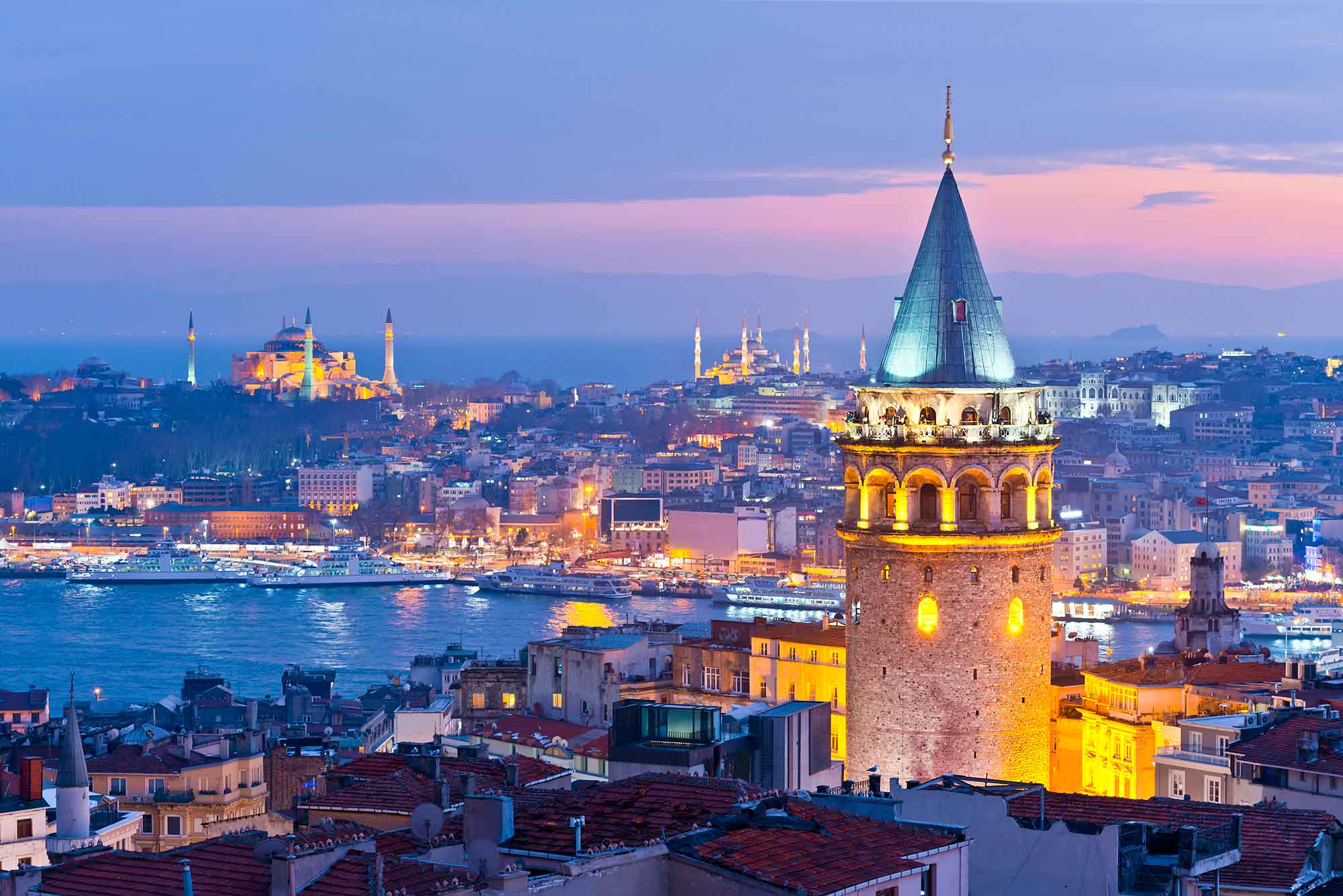
The Historic Peninsula still contains monuments of Roman, Byzantine, and Ottoman Constantinople.
The Bosphorus continues to divide and connect Europe and Asia.
The Golden Horn remains surrounded by neighborhoods shaped by centuries of religious, commercial, and community history.
Modern Istanbul therefore exists alongside—and often directly on top of—its ancient and imperial past.
Why Istanbul’s History Is So Unique
Many cities have belonged to different civilizations.
What makes Istanbul exceptional is the scale and continuity of its role.
It served as an imperial capital for more than 1,500 years, first within the Roman and Byzantine world and later as the center of the Ottoman Empire.
Christian emperors worshipped in Hagia Sophia. Ottoman sultans governed from Topkapi Palace. Chariot races once filled the Hippodrome. Merchants traded beneath the domes of the Grand Bazaar. Greek Orthodox, Armenian, Jewish, Muslim, Catholic, and other communities built institutions that still contribute to the city’s cultural landscape.
These histories are not separated neatly into different parts of Istanbul.
They frequently occupy the same spaces.
A Byzantine church may later have become an Ottoman mosque. Ancient columns were incorporated into later buildings. Ottoman neighborhoods developed around Byzantine monuments. Modern streets follow routes shaped by cities that existed centuries earlier.
This layering is one of the reasons Istanbul can never be understood through a single monument or historical period.
Discover the History of Istanbul Through Its Monuments
Much of Istanbul’s history remains visible today.
At Hagia Sophia, visitors encounter Byzantine architecture, Christian mosaics, Ottoman additions, and the continuing religious life of the building.
The Hippodrome reveals the ceremonial heart of ancient Constantinople, while the Basilica Cistern demonstrates the engineering achievements that sustained the Byzantine capital.
At Topkapi Palace, visitors can explore the political and ceremonial world of the Ottoman court.
The Suleymaniye Mosque represents the architectural achievement of the classical Ottoman period, while Dolmabahce Palace reflects the changing empire of the 19th century.
Neighborhoods such as Fener and Balat preserve important Greek Orthodox and Jewish heritage, while Galata and Pera reveal the international and cosmopolitan character of later Ottoman Istanbul.
Exploring these places together allows the history of the city to emerge not as a collection of isolated dates, but as one continuous story.
A City Where the Past Is Still Present
Istanbul is sometimes described simply as a city where East meets West.
Its history is considerably richer than that phrase suggests.
It is a city where ancient Greece, Rome, Byzantium, Ottoman civilization, Christianity, Islam, Judaism, European influences, and modern Turkey have all contributed to an extraordinarily complex urban identity.
Byzantium did not simply disappear when Constantinople was created.
Constantinople did not simply disappear in 1453.
And the Ottoman capital did not vanish with the establishment of the Turkish Republic.
Each period transformed what came before it while leaving traces for the generations that followed.
That continuity is what makes exploring Istanbul so rewarding.
The modern city is not separate from its history.
It is the latest chapter of it.
Explore the History of Istanbul With a Private Guide
Discover more than two thousand years of Istanbul’s history and experience the remarkable stories behind its monuments and neighborhoods with your own private guide. From Byzantine Constantinople and Hagia Sophia to the palaces, mosques, bazaars, and multicultural communities of the Ottoman capital, our private tours can be tailored around the historical periods and places that interest you most.
Whether you are fascinated by Roman and Byzantine history, Ottoman architecture, Christian heritage, Jewish heritage, archaeology, or the transformation of Istanbul into a modern metropolis, we can create a personalized itinerary designed around your interests, schedule, and pace.