

Discover Istanbul’s Remarkable Iron Church on the Golden Horn
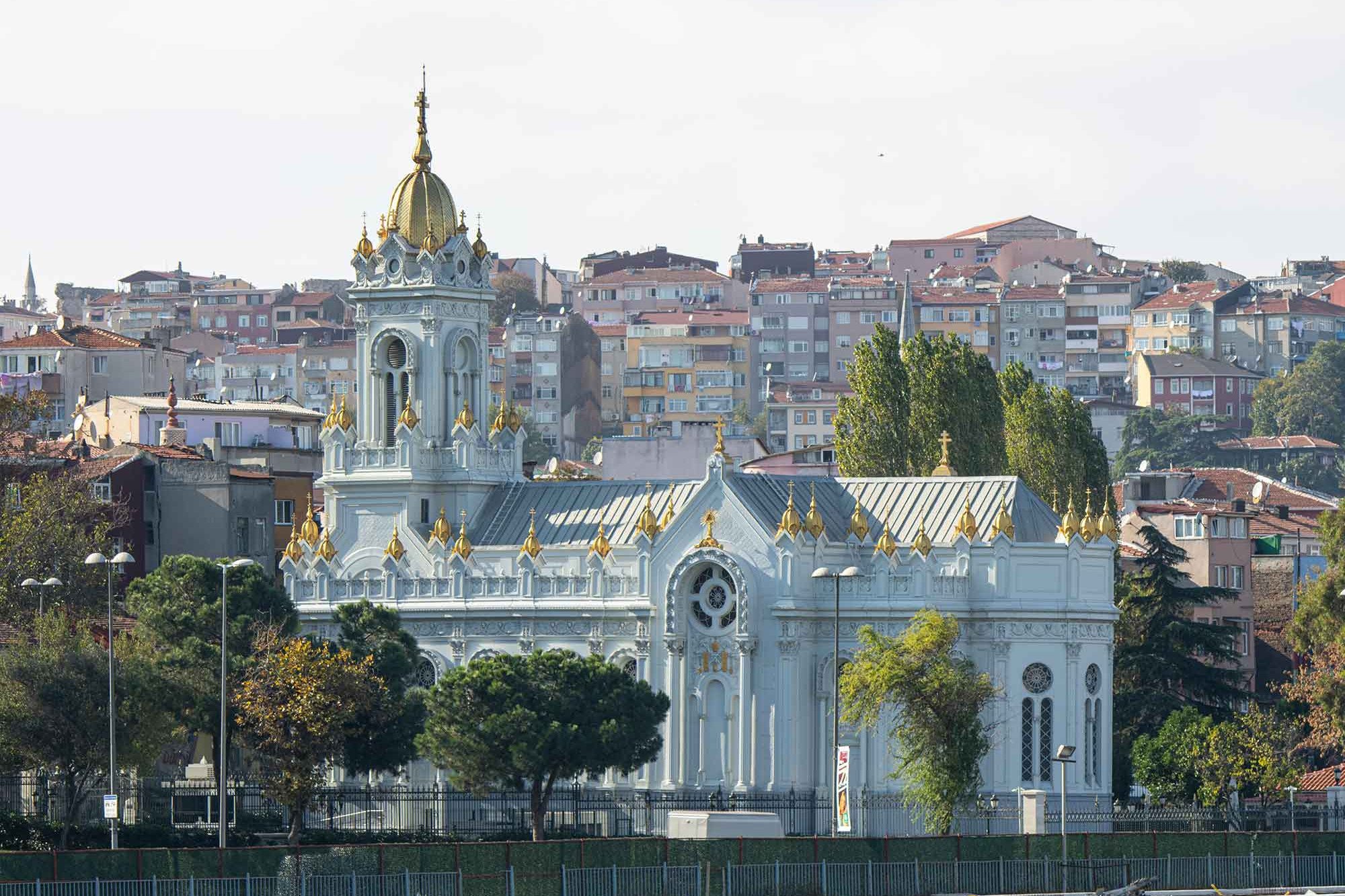
Standing directly beside the Golden Horn between the historic districts of Fener and Balat, the Bulgarian St. Stephen Church is one of the most distinctive Christian monuments in Istanbul.
Commonly known as the Iron Church, the present building was completed in 1898 and is remarkable for its extensive use of prefabricated iron and steel components. Its structural and decorative elements were manufactured in Vienna, transported to Istanbul, and assembled on the shores of the Golden Horn.
Yet the importance of St. Stephen extends far beyond its unusual architecture.
The church is closely connected with the history of Istanbul’s Bulgarian Orthodox community and the 19th-century movement that eventually led to the establishment of an independent Bulgarian Exarchate within the Ottoman Empire.
Its history therefore brings together religion, architecture, Ottoman reform, Bulgarian identity, and the multicultural Christian heritage of Istanbul.
Why Is It Called the Iron Church?
The Bulgarian St. Stephen Church is popularly known as the Iron Church because metal was used extensively throughout its construction.
The structural framework was created using prefabricated metal components, while large sections of the exterior were formed from iron elements and metal panels.
This was an extraordinary method of construction for a monumental church in the late 19th century.
The components were manufactured in Vienna by the Austrian company Rudolf Philipp Waagner, transported to Istanbul, and assembled on the site.
Approximately 500 tons of iron are traditionally associated with the construction.
The result is one of the most unusual surviving examples of prefabricated metal ecclesiastical architecture from the 19th century.
The Bulgarian Community in Ottoman Istanbul
Bulgarian Orthodox Christians formed part of the remarkably diverse Christian population of the Ottoman Empire.
For centuries, Orthodox Christians within the empire were religiously connected with the Ecumenical Patriarchate of Constantinople.
During the 19th century, however, growing cultural and national movements transformed communities throughout the Balkans.
Among Bulgarians, increasing emphasis was placed on the use of the Bulgarian language in worship, education, and religious administration.
These developments gradually produced demands for greater ecclesiastical independence from the Greek-dominated Patriarchate.
Istanbul became one of the principal centers of this movement.
Stefan Bogoridi and the First Bulgarian Church
An important figure in the establishment of a Bulgarian church in Istanbul was Stefan Bogoridi, a prominent Ottoman statesman of Bulgarian origin.
In 1849, Bogoridi donated property on the shore of the Golden Horn for use by the Bulgarian community.
A wooden building on the property was adapted for worship and became the first Bulgarian church on the site.
The church was dedicated to St. Stephen, the first Christian martyr and one of the seven men traditionally identified as the first deacons in the Book of Acts.
The dedication also reflected the name of the church’s benefactor, Stefan Bogoridi.
This modest wooden church would become one of the most important locations in the development of Bulgarian ecclesiastical independence.
St. Stephen the First Martyr
The church is dedicated to St. Stephen, one of the earliest figures of the Christian Church.
According to the Acts of the Apostles, Stephen was chosen together with six other men to assist the early Christian community in Jerusalem.
He became known for his preaching and was eventually brought before the religious authorities.
After delivering a lengthy defense of his faith, Stephen was executed by stoning.
Christian tradition therefore remembers him as the Protomartyr — the first martyr to die for his Christian faith.
His story is told principally in Acts chapters 6 and 7.
The Struggle for an Independent Bulgarian Church
During the decades following the establishment of the wooden St. Stephen Church, the movement for an independent Bulgarian ecclesiastical organization became increasingly important.
The issue involved language, education, church administration, episcopal authority, and the growing sense of Bulgarian cultural identity.
The Bulgarian community sought the right to manage its own religious institutions rather than remaining completely under the authority of the Greek Orthodox hierarchy in Constantinople.
Because Istanbul was the Ottoman capital, negotiations over the status of the Bulgarian Church took place directly within the political center of the empire.
St. Stephen became closely associated with these developments.
The Establishment of the Bulgarian Exarchate
A decisive moment came in 1870, when the Ottoman government issued an imperial decree establishing the Bulgarian Exarchate.
The decree granted the Bulgarian Orthodox community a separate ecclesiastical organization within the Ottoman system.
The decree establishing the Exarchate was publicly proclaimed at St. Stephen, giving the church an exceptional place in Bulgarian religious history.
The creation of the Exarchate was not merely an administrative change.
It represented a major stage in the development of Bulgarian religious and cultural identity during the final decades of Ottoman rule in the Balkans.
The Bulgarian Exarchate and the Ecumenical Patriarchate
The establishment of the Bulgarian Exarchate created a serious dispute with the Ecumenical Patriarchate of Constantinople.
The conflict involved questions of ecclesiastical jurisdiction as well as the growing role of national identity within Orthodox Christianity.
In 1872, a council in Constantinople condemned the ecclesiastical division and declared the Bulgarian hierarchy schismatic.
The separation between the Bulgarian Church and the Ecumenical Patriarchate would continue for decades.
Reconciliation was eventually achieved in the 20th century, when the schism was lifted and communion was restored.
The Iron Church therefore stands within a complicated chapter of Orthodox Christian history involving both religious authority and emerging national identities.
Why Was a New Church Needed?
The original wooden church was never intended to serve permanently as the monumental center of the Bulgarian Orthodox community in Istanbul.
As the community’s institutional importance increased, plans developed for a larger and more impressive church.
Building on the shoreline of the Golden Horn, however, presented a serious engineering problem.
The ground was considered unsuitable for the weight of a conventional monumental masonry structure.
A lighter construction system offered an innovative solution.
Instead of relying upon a massive stone building, the new church could be created using prefabricated metal components.
Hovsep Aznavur: Architect of the Iron Church
The design of the present church is associated with Hovsep Aznavur, an Ottoman Armenian architect active in Istanbul.
Aznavur created an ambitious church combining a traditional Christian plan with the possibilities offered by modern industrial construction.
His design demonstrates the cosmopolitan character of late Ottoman Istanbul.
A Bulgarian Orthodox church in the Ottoman capital was designed by an Armenian architect, manufactured with the assistance of an Austrian industrial company, and assembled from components produced in Vienna.
Few monuments illustrate the international character of 19th-century Istanbul quite as clearly.
A Church Manufactured in Vienna
The metal components of St. Stephen were manufactured by the Austrian firm Rudolf Philipp Waagner in Vienna.
The building was effectively prefabricated.
Its structural and decorative elements were manufactured and prepared before being transported to Istanbul.
The components were then shipped to the Ottoman capital and assembled on the Golden Horn.
This construction method places St. Stephen within the wider history of the Industrial Revolution and the increasing use of iron and steel in 19th-century architecture.
Railway stations, bridges, exhibition halls, markets, factories, and other buildings were increasingly demonstrating the architectural possibilities of metal.
At St. Stephen, those technologies were applied to a Christian church.
An Extraordinary Example of Prefabricated Architecture
Prefabrication may appear to be a modern concept, but St. Stephen demonstrates how sophisticated the technique had already become by the late 19th century.
Individual elements could be manufactured to standardized specifications, transported over great distances, and assembled at their final destination.
The Iron Church is particularly remarkable because the metal components were not limited to a hidden structural skeleton.
Metal became an essential part of the building’s architectural identity.
Columns, walls, decorative elements, exterior surfaces, and structural components combine to create the appearance of a monumental traditional church through industrial materials.
When Was the Iron Church Built?
The present Bulgarian St. Stephen Church was constructed during the final years of the 19th century and officially opened in 1898.
By this time, the political world surrounding the Bulgarian community had changed dramatically.
Bulgaria had already emerged from direct Ottoman rule following the Russo-Turkish War of 1877-1878 and the political settlements that followed.
Yet Istanbul remained an important center of Bulgarian ecclesiastical life.
The completion of the new church therefore represented both continuity with the earlier Bulgarian community in the Ottoman capital and a new expression of Bulgarian religious identity.
Architecture of the Iron Church
The architecture of St. Stephen reflects the eclectic artistic environment of the late 19th century.
Its design incorporates influences associated with Neo-Gothic, Neo-Baroque, and other European revival styles.
From a distance, the church may initially appear to be constructed from conventional masonry.
A closer examination reveals the extraordinary nature of its surfaces and decorative details.
The building demonstrates how industrial materials could be shaped to imitate or reinterpret architectural forms traditionally produced in stone, plaster, or carved ornament.
The Exterior
The exterior of St. Stephen is particularly striking because of its elaborate metal decoration.
Arches, columns, window frames, cornices, reliefs, and ornamental details create a richly articulated facade.
The pale exterior gives the building an elegant appearance beside the waters of the Golden Horn.
Its architectural language is unmistakably 19th century, reflecting the same wider period of stylistic experimentation that produced many of Istanbul’s late Ottoman palaces, churches, apartments, and public buildings.
Yet the material from which St. Stephen was constructed makes it fundamentally different from almost every other historic church in the city.
The Bell Tower
The entrance facade is dominated by an impressive bell tower rising to approximately 40 meters.
The vertical emphasis of the tower contributes significantly to the church’s appearance from the Golden Horn.
Its bells were produced in Yaroslavl, Russia, demonstrating another international connection within the history of the building.
The tower also provides an architectural counterpoint to the domes and horizontal form of the church below.
Inside the Iron Church
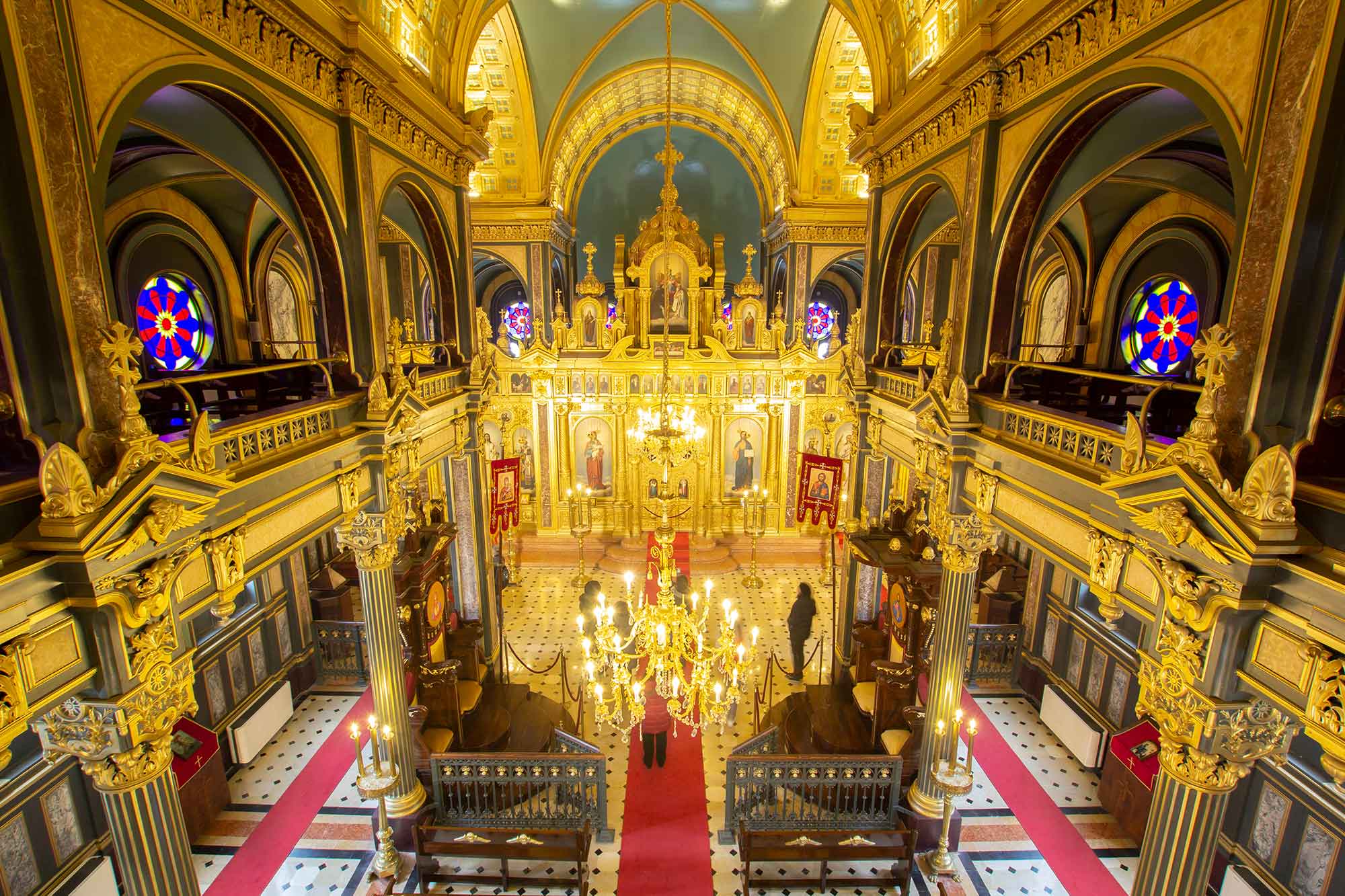
The interior of St. Stephen is warmer and more ornate than visitors might expect from a building popularly described simply as an “iron church.”
Columns, arches, chandeliers, icons, decorative surfaces, and the elaborate iconostasis create the atmosphere of an Orthodox place of worship rather than an industrial structure.
The metal construction becomes part of a richly decorated sacred interior.
This contrast between industrial engineering and traditional Orthodox liturgical space is one of the most fascinating aspects of the church.
The Iconostasis
One of the most important elements inside an Orthodox church is the iconostasis.
This decorated screen separates the sanctuary from the nave and contains icons arranged according to Orthodox liturgical traditions.
At St. Stephen, the richly decorated iconostasis forms the visual and religious focus of the interior.
Icons of Christ, the Virgin Mary, saints, and biblical figures connect the church with the wider artistic traditions of Eastern Orthodox Christianity.
Understanding the iconostasis also helps visitors appreciate that Orthodox church architecture is organized around liturgical functions rather than decoration alone.
Icons and Orthodox Worship
Icons occupy an essential place within Orthodox Christian spirituality.
They are not regarded simply as religious paintings.
Within Orthodox tradition, icons serve as sacred images directing the believer toward Christ, the Virgin Mary, saints, and events of salvation history.
Their placement within a church follows established theological and liturgical traditions.
Visitors unfamiliar with Orthodox Christianity may therefore find that understanding the role of the icons greatly enriches the experience of visiting St. Stephen.
The Iron Church and Ottoman Religious Diversity
St. Stephen is also an important reminder of the extraordinary religious diversity of Ottoman Istanbul.
The city was home to Muslims, Greek Orthodox Christians, Armenian Christians, Catholics, Jews, Bulgarians, Syriac Christians, Protestants, and other communities.
These communities established mosques, churches, synagogues, schools, hospitals, charitable institutions, cemeteries, and cultural organizations throughout the city.
The Bulgarian Iron Church represents one chapter within this much broader story.
Its presence beside the Golden Horn demonstrates how the history of Istanbul cannot be understood through the monuments of a single community alone.
The Iron Church and the Tanzimat Era
The history of St. Stephen also belongs to the wider transformation of the Ottoman Empire during the Tanzimat period.
Beginning in the 19th century, Ottoman governments introduced a series of administrative, legal, educational, and social reforms.
The position of non-Muslim communities within the empire was one of the issues affected by these changes.
Christian and Jewish communities gained greater opportunities to construct, enlarge, and restore places of worship during the 19th century.
The development of St. Stephen should therefore be understood within both the Bulgarian ecclesiastical movement and the changing political environment of the late Ottoman Empire.
Fener, Balat and the Christian Heritage of Istanbul
The location of St. Stephen makes it particularly valuable for visitors interested in the Christian history of Istanbul.
Nearby Fener has been closely associated with the Ecumenical Patriarchate of Constantinople and the Greek Orthodox community.
Balat was historically home to important Jewish and Christian communities.
Churches, synagogues, schools, historic houses, and religious institutions survive throughout these neighborhoods.
The Iron Church adds the Bulgarian Orthodox story to this remarkable concentration of religious and cultural heritage.
St. Stephen and the Ecumenical Patriarchate
Visiting both the Bulgarian St. Stephen Church and the Ecumenical Patriarchate provides an especially interesting perspective on 19th-century Orthodox history.
The two institutions are geographically close but historically represent different aspects of the Orthodox world.
The Ecumenical Patriarchate preserves the ancient tradition of the Church of Constantinople.
St. Stephen is closely associated with the Bulgarian movement for an independent ecclesiastical organization.
Understanding the relationship between them reveals how questions of language, identity, nationality, and church authority transformed Orthodox Christianity during the 19th century.
Restoration of the Iron Church
More than a century beside the Golden Horn inevitably affected the metal structure of St. Stephen.
Moisture, corrosion, environmental conditions, and the natural deterioration of materials created significant conservation challenges.
The church therefore underwent an extensive restoration lasting several years.
The project addressed both structural and decorative elements and represented an important effort to preserve this unusual example of 19th-century architecture.
Following the restoration, the church was ceremonially reopened in January 2018.
A Symbol of Turkish-Bulgarian Cultural Heritage
The restoration and reopening of St. Stephen also emphasized the church’s significance beyond the Bulgarian Orthodox community.
Today, the building represents an important element of the shared cultural heritage connecting Turkey and Bulgaria.
Its preservation demonstrates how Istanbul’s historic monuments reflect the many communities that contributed to the city’s identity.
The church continues to serve its religious function while also welcoming visitors interested in architecture, Christian history, and the multicultural heritage of Istanbul.
Visiting the Iron Church Today
The Bulgarian St. Stephen Church remains an active Orthodox church as well as a historic monument.
Visitors can experience its unusual metal architecture, decorated interior, iconostasis, and exceptional location beside the Golden Horn.
Because the church remains a functioning place of worship, access may occasionally be affected by religious services, ceremonies, special events, or maintenance.
Visitors should approach the church respectfully and follow any instructions provided by church staff.
Is There an Entrance Fee?
There is normally no entrance ticket required to visit the Bulgarian St. Stephen Church.
As with other active religious buildings in Istanbul, visiting arrangements may occasionally change according to services or special circumstances.
The church can therefore be incorporated easily into a private tour of Fener, Balat, the Golden Horn, or Istanbul’s Christian heritage.
Dress Code and Respectful Visiting
Visitors should dress respectfully when entering the church.
As an active Christian place of worship, conversations should be kept at an appropriate volume, particularly when services or prayers are taking place.
Photography should also be approached respectfully.
Visitors should follow any current restrictions concerning photography and avoid disturbing worshippers.
How Much Time Should You Allow?
Approximately 30 to 45 minutes is generally sufficient to explore the church and understand its principal architectural and historical features.
Visitors particularly interested in Christian history, Orthodox Christianity, architecture, or the Bulgarian community may wish to spend longer.
The church is especially rewarding when visited as part of a broader exploration of Fener and Balat rather than as an isolated monument.
Visiting the Iron Church with a Private Guide
The unusual architecture of the Iron Church is immediately impressive, but its historical significance becomes much clearer when placed within the wider story of Ottoman Istanbul.
With your own licensed private guide, you can discover why the Bulgarian community established its own church, how the Bulgarian Exarchate emerged, why the building was constructed from prefabricated metal, and how its components traveled from Vienna to Istanbul.
Your guide can also explain the basic traditions of Orthodox church architecture, the role of the iconostasis, and the relationship between the Bulgarian Church and the Ecumenical Patriarchate.
The visit then becomes much more than seeing an unusual metal building.
It becomes a window into the religious, political, and cultural transformation of the Ottoman Empire during the 19th century.
Explore the Christian Heritage of Fener and Balat
The Iron Church can be naturally combined with other important religious and historic sites around the Golden Horn.
A private tour may include the Ecumenical Patriarchate of Constantinople, historic Greek Orthodox churches, the streets of Fener and Balat, sections of the Theodosian Walls, and other monuments connected with Istanbul’s Christian communities.
For visitors interested in a broader Christian heritage itinerary, the church can also be combined with Hagia Sophia, Chora Church, Hagia Irene, and other important sites across Istanbul.
Together, these monuments reveal different chapters in the city’s extraordinary Christian history, from Byzantine Constantinople to the diverse Christian communities of the Ottoman period.
Discover the Iron Church as Part of Your Private Istanbul Tour
Explore one of Istanbul’s most unusual churches and discover the remarkable story of the Bulgarian Orthodox community on the Golden Horn.
Learn how St. Stephen Church developed from a modest wooden place of worship into an extraordinary prefabricated iron structure, discover the rise of the Bulgarian Exarchate, and explore a monument where architecture, religion, engineering, and Ottoman history come together.
With Eskinazi Tours & Events, the Bulgarian St. Stephen Church can be incorporated into a personalized private tour focusing on Christian heritage, Ottoman religious communities, Fener and Balat, architecture, or the multicultural history of Istanbul.
Contact us to create a personalized private tour of Istanbul and discover the remarkable history and architecture of the Bulgarian Iron Church.