

Discover the Medieval Landmark Rising Above the Golden Horn
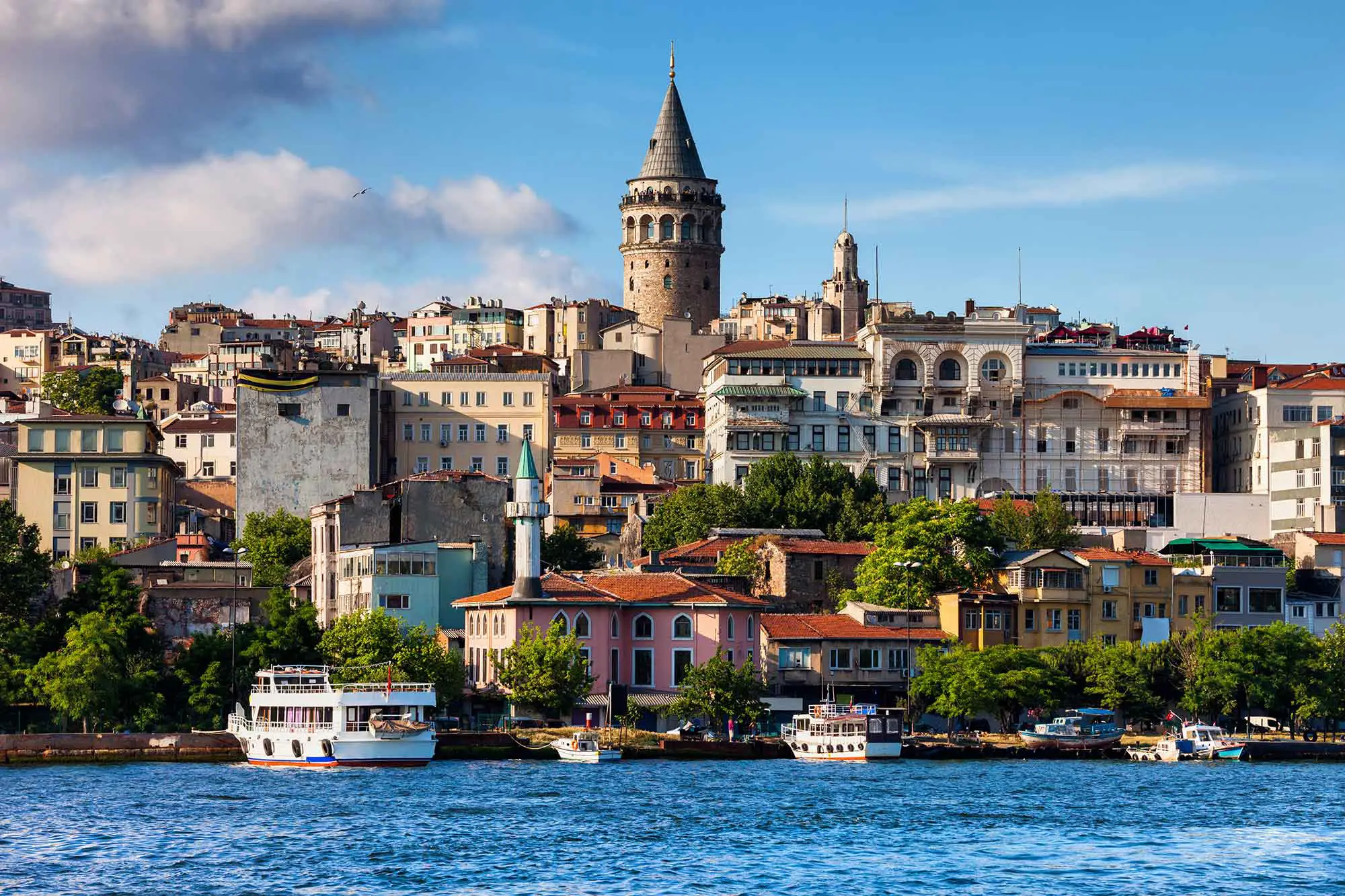
Rising above the historic streets of Galata, the Galata Tower is one of the most recognizable landmarks on the Istanbul skyline.
The present tower was constructed by the Genoese in 1348, when Galata was home to an important Genoese trading colony across the Golden Horn from Byzantine Constantinople.
Originally forming part of the fortified walls surrounding the Genoese settlement, the tower later served several different purposes under the Ottoman Empire, including use as a prison and a lookout for detecting fires across the city.
Today, Galata Tower functions as a museum and observation point, offering extraordinary panoramic views over the Golden Horn, Bosphorus, historic peninsula, and the modern districts of Istanbul.
Its history reflects something even larger: Istanbul’s position for centuries at the intersection of Byzantine, Genoese, Ottoman, Mediterranean, and European worlds.
Where Is Galata Tower?
Galata Tower stands in the historic Galata district of modern Beyoglu, on the northern side of the Golden Horn.
Its elevated position explains why the tower dominates the surrounding skyline.
From the tower, the historic peninsula lies directly across the Golden Horn, while the Bosphorus extends toward the north and the Sea of Marmara opens toward the south.
The neighborhoods of Karakoy, Galata, Pera, and Istiklal Street surround the tower, making it an excellent starting point for exploring a very different side of Istanbul from Sultanahmet.
Why Is Galata So Important?
Galata’s location opposite Constantinople made it one of the most strategically important commercial districts of the medieval city.
Ships entering the Golden Horn passed directly beside the settlement.
Merchants operating from Galata could participate in trading networks connecting the Mediterranean, Black Sea, Europe, Anatolia, and regions farther east.
The district therefore developed an identity distinct from the imperial city across the water.
Understanding Galata Tower means understanding this extraordinary maritime and commercial environment.
Galata Before the Genoese
The area around Galata had been inhabited long before the construction of the present tower.
Its position outside the principal walls of Constantinople but directly opposite the imperial capital made the northern shore of the Golden Horn strategically valuable throughout the Byzantine period.
There are references to earlier fortifications and towers in the broader area.
However, the tower standing today should not simply be described as a surviving Byzantine tower.
The existing Galata Tower is fundamentally the product of the Genoese settlement of the 14th century, although later Ottoman restorations significantly altered its appearance.
The Genoese in Constantinople
The Republic of Genoa was one of the great maritime powers of the medieval Mediterranean.
Genoese merchants established trading colonies and commercial networks extending across the Mediterranean and Black Sea.
Constantinople occupied an exceptionally important position within these networks.
Following major political changes in the Byzantine Empire during the 13th century, the Genoese established themselves in Galata, also known in medieval European sources as Pera.
The settlement gradually developed into a prosperous fortified commercial colony immediately across the Golden Horn from Constantinople.
The Genoese Colony of Galata
The Genoese colony expanded during the late 13th and 14th centuries.
Although it existed within the political world of the Byzantine Empire, Galata developed its own institutions, commercial buildings, churches, houses, warehouses, and fortifications.
Walls and defensive towers protected the settlement.
The Galata Tower was constructed as part of this fortified system.
For merchants arriving from the Mediterranean or Black Sea, Galata became one of the most important commercial centers in the region.
When Was Galata Tower Built?
The present Galata Tower dates to 1348.
It was constructed during a period when the Genoese were strengthening and expanding the defenses of their settlement.
The tower occupied a commanding position at one of the highest points within the fortified district.
Its location allowed observation of the surrounding landscape, the Golden Horn, maritime traffic, and approaches to the settlement.
Although repeatedly altered during later centuries, the massive stone body of the tower still preserves the character of its medieval origins.
The Tower of Christ
During the Genoese period, Galata Tower was known as the Tower of Christ, or Christea Turris.
The name reflects the Christian identity of the Genoese colony and distinguishes the tower from earlier structures that existed elsewhere around the Golden Horn.
The tower formed part of a larger defensive network rather than standing alone as it does today.
Walls extended through the district and were reinforced by additional towers and gates.
Most of these fortifications eventually disappeared as Istanbul expanded, leaving Galata Tower as the most impressive surviving monument of Genoese Galata.
Architecture of Galata Tower
Galata Tower has a massive cylindrical stone body rising above the surrounding neighborhood.
Its thick masonry walls reflect its original defensive purpose.
The appearance of the upper levels, windows, observation area, and distinctive conical roof developed through centuries of Ottoman repairs and reconstruction.
The building seen today should therefore be understood as a monument with several historical layers.
Its medieval Genoese core survives within a structure repeatedly adapted to the changing needs of Ottoman and modern Istanbul.
Galata Tower and the Medieval Skyline
During the Middle Ages, the tower must have appeared even more dominant than it does today.
Galata was filled with smaller houses, churches, warehouses, workshops, and commercial buildings.
The tower rose above them as part of the fortified skyline overlooking the Golden Horn.
Across the water stood Constantinople, with its enormous defensive walls, imperial palaces, churches, and the great dome of Hagia Sophia.
The two shores represented different but deeply connected worlds: the Byzantine imperial capital and the maritime commercial colony of Galata.
Galata and the Byzantine Empire
Relations between the Genoese of Galata and the Byzantine Empire were complex.
The two communities depended upon one another economically, yet political tensions periodically emerged.
The Genoese possessed considerable commercial privileges and maintained extensive international trading connections.
From Galata, their merchants could participate in commerce throughout the Black Sea and Mediterranean.
The colony therefore became both an economic asset and a politically sensitive presence immediately beside the Byzantine capital.
Galata and the Fall of Constantinople
When Sultan Mehmed II besieged Constantinople in 1453, Galata occupied a delicate political position.
The Genoese colony was officially expected to maintain neutrality, although individuals from the Genoese community became involved in the defense of Constantinople.
One of the most famous Genoese commanders associated with the final defense was Giovanni Giustiniani Longo, who fought alongside Byzantine Emperor Constantine XI.
After Constantinople fell on May 29, 1453, Galata also came under Ottoman control.
The Genoese commercial colony was incorporated into the rapidly changing Ottoman capital.
Galata Under the Ottoman Empire
The Ottoman conquest did not bring an end to Galata’s commercial importance.
The district continued to be home to merchants, sailors, diplomats, craftsmen, and religious communities with international connections.
Its position beside the principal port areas of the Golden Horn ensured that commerce remained central to its identity.
Galata Tower, however, gradually lost its original defensive role.
Over the following centuries, the Ottomans adapted the structure for several different purposes.
Galata Tower as a Prison
During part of the Ottoman period, Galata Tower was used as a prison.
Under Sultan Suleyman the Magnificent, prisoners associated with work at the Ottoman naval facilities around the Golden Horn were held within the tower.
This was a very different function from the defensive purpose for which the Genoese had constructed it.
The change demonstrates how historic structures in Istanbul were repeatedly adapted according to the changing needs of the city.
The Ottoman Naval Arsenal and the Golden Horn
The Golden Horn became increasingly important to Ottoman naval power.
Major naval facilities developed around Kasimpasa, where the imperial arsenal became one of the principal shipbuilding centers of the Ottoman Empire.
Galata Tower stood above this maritime landscape.
From its position, the tower overlooked the harbor, shipyards, commercial vessels, and neighborhoods that supported the naval and economic life of the Ottoman capital.
Its history is therefore closely connected not only with Galata itself but also with the wider maritime history of Istanbul.
An Observatory Above Istanbul
During the late 16th century, Galata Tower also became associated with Ottoman astronomy.
The celebrated scholar Taqi al-Din established an astronomical observatory in Istanbul during the reign of Sultan Murad III.
Galata Tower is sometimes associated with observational activity connected with this period before Taqi al-Din’s principal observatory operated elsewhere in the city.
The episode belongs to a broader history of Ottoman scientific interest in astronomy, mathematics, calendars, navigation, and the observation of the heavens.
Hezarfen Ahmed Celebi and the Flight from Galata Tower
Perhaps the most famous story connected with Galata Tower concerns Hezarfen Ahmed Celebi.
According to the 17th-century Ottoman traveler Evliya Celebi, Hezarfen constructed artificial wings and launched himself from the top of Galata Tower.
The story says that he crossed the Bosphorus and landed at Doganclar Square in Uskudar on the Asian side.
It has become one of the great legends of Istanbul.
Did Hezarfen Really Fly Across the Bosphorus?
The story of Hezarfen Ahmed Celebi should be approached with some historical caution.
The principal account comes from Evliya Celebi, whose enormous travel narrative combines valuable historical observations with remarkable stories, humor, exaggeration, and elements that are difficult to verify independently.
There is no strong contemporary documentation confirming the flight exactly as described.
For this reason, it is better understood as a celebrated Ottoman account or legend rather than an event that can be established with certainty.
Regardless of its historical verifiability, the story has become inseparable from the cultural memory of Galata Tower.
Galata Tower as a Fire Watchtower
Fire was one of the greatest dangers facing Ottoman Istanbul.
Large sections of the city were traditionally built with timber, and densely populated neighborhoods could be devastated when flames spread from one building to another.
Because of its height and commanding position, Galata Tower was ideally suited for observing the city.
By the 18th century, it was being used as a fire watchtower.
Watchmen could observe smoke rising from distant neighborhoods and help alert the city to developing fires.
Fires Inside the Tower
Ironically, the tower used to watch for fires was itself repeatedly damaged by fire.
Major fires affected Galata Tower during the Ottoman period, including destructive events in the late 18th and early 19th centuries.
Each restoration altered elements of the building.
These repeated cycles of destruction and rebuilding explain why the upper section of the tower cannot be attributed entirely to its medieval Genoese builders.
Galata Tower is a monument shaped by nearly seven centuries of adaptation.
The 1509 Earthquake
Istanbul has experienced numerous destructive earthquakes throughout its history.
The severe earthquake of 1509, remembered in Ottoman sources as the Little Apocalypse, damaged buildings throughout the city.
Galata Tower was among the structures affected.
Repairs followed during the Ottoman period.
Earthquakes, fires, storms, and centuries of continuous use would repeatedly require further interventions.
The Conical Roof
The distinctive conical roof is now one of the defining features of Galata Tower.
However, the tower’s upper appearance changed repeatedly over the centuries.
After fires and restorations during the Ottoman period, new upper floors and architectural features were introduced.
A storm in 1875 destroyed the roof, leaving the tower with a very different silhouette for decades.
The familiar conical roof was restored during the major 20th-century restoration.

Galata Tower in the 19th Century
During the 19th century, the neighborhoods around Galata underwent enormous transformation.
Galata and nearby Pera became centers of banking, international commerce, diplomacy, hotels, theaters, churches, apartments, and European-style urban life.
Foreign embassies and Levantine communities contributed to the cosmopolitan character of the district.
While the medieval tower remained above the neighborhood, the city surrounding it was becoming increasingly modern.
This contrast between medieval monument and 19th-century cosmopolitan district remains one of the defining characteristics of Galata today.
Galata and the Bankers of the Ottoman Empire
During the later Ottoman period, Galata became one of the financial centers of the empire.
Banks, trading companies, insurance firms, and wealthy merchants established themselves in the surrounding streets.
The district was particularly associated with the famous Galata bankers, financiers who played important roles in Ottoman economic life.
The nearby Bankalar Caddesi, or Banks Street, still preserves monumental buildings from this period.
Exploring the neighborhood around Galata Tower therefore reveals several completely different chapters of Istanbul’s economic history.
The Multicultural World of Galata
Galata was historically one of the most diverse areas of Istanbul.
Its population included Muslims, Greek Orthodox Christians, Armenians, Jews, Catholics, Levantines, and European merchants from several countries.
Churches, synagogues, mosques, schools, foreign institutions, commercial buildings, and residences developed within a relatively compact district.
The neighborhood’s architecture still reflects elements of this multicultural past.
Galata Tower stands at the center of this historical landscape.
Galata Tower and Istanbul’s Jewish History
Galata also became an important area for Istanbul’s Jewish community.
Jewish settlement in and around Galata expanded during different periods of Ottoman history, particularly as the commercial districts north of the Golden Horn developed.
Several synagogues were established in the surrounding neighborhoods.
The Neve Shalom Synagogue and the Ashkenazi Synagogue remain among the best-known Jewish institutions in the wider Galata area today.
For this reason, Galata Tower can also form part of a broader exploration of Istanbul’s Jewish heritage.
The Genoese Heritage Around Galata
Although most of the medieval Genoese walls have disappeared, traces of Genoese Galata can still be discovered around the neighborhood.
Street patterns, surviving fragments, historic churches, underground remains, and the tower itself provide clues to the medieval settlement.
The modern city has grown over this earlier landscape, making many elements difficult to recognize without historical context.
Galata Tower remains the most powerful visual reminder that a fortified Genoese commercial colony once stood here.
Restoration in the 20th Century
By the middle of the 20th century, Galata Tower required extensive restoration.
Major work was carried out between 1965 and 1967.
The building was stabilized and adapted for visitors, while the distinctive conical roof was reconstructed in a form inspired by its earlier Ottoman appearance.
For decades afterward, the tower became one of Istanbul’s most popular panoramic attractions.
Its function gradually shifted from practical urban infrastructure to cultural monument and tourist landmark.
Galata Tower Becomes a Museum
Another major restoration was undertaken in 2020.
Later additions that were considered inappropriate to the historic character of the structure were removed, and the interior was reorganized as a museum.
The tower reopened to visitors in October 2020.
Today, the building is officially operated as the Galata Tower Museum.
Its exhibitions introduce aspects of the history of Istanbul while the upper levels provide the panoramic experience for which the tower is particularly famous.
Recent Conservation of Galata Tower
Galata Tower has continued to undergo conservation work in recent years.
Restoration and structural investigations have addressed the roof, exterior surfaces, seismic protection, and other elements of the historic structure.
The conservation process has also taken into consideration the migratory birds that nest within openings in the tower’s masonry.
These interventions reflect the challenge of preserving a medieval structure that receives very large numbers of visitors while remaining exposed to Istanbul’s weather, seismic activity, and dense urban environment.
The View from Galata Tower
The panoramic view is one of the principal reasons to visit Galata Tower.
From the upper level, visitors can understand the geography of Istanbul in a way that is difficult to appreciate from street level.
Across the Golden Horn rises the historic peninsula.
The skyline includes the domes and minarets associated with Hagia Sophia, Topkapi Palace, Suleymaniye Mosque, and other monuments.
The Bosphorus stretches toward the north, while the Asian side of Istanbul appears across the water.
The view helps explain why this location was strategically important to the Genoese.
Understanding Istanbul from Above
Galata Tower is particularly valuable at the beginning of a visit to Istanbul because the panorama provides a visual introduction to the city.
The Golden Horn separates Galata from the historic peninsula.
The Bosphorus divides Europe and Asia.
The Sea of Marmara connects Istanbul with the Dardanelles and Mediterranean.
The hills of the historic peninsula reveal the monumental geography of the Byzantine and Ottoman capitals.
From the tower, Istanbul’s complicated geography suddenly becomes much easier to understand.
Galata Tower and the Golden Horn
The relationship between Galata Tower and the Golden Horn is fundamental to its history.
The Genoese settlement prospered partly because it stood beside this extraordinary natural harbor.
Across the water lay Constantinople’s commercial districts and imperial center.
Ships arriving from the Mediterranean and Black Sea passed through a maritime landscape filled with docks, warehouses, merchants, sailors, and markets.
The tower’s position above the harbor allowed it to observe one of the busiest commercial environments of the medieval world.
Galata Tower and the Bosphorus
The tower also offers a remarkable perspective over the Bosphorus.
The strait connects the Black Sea with the Sea of Marmara and ultimately the Mediterranean.
Control of these waterways contributed enormously to the strategic importance of Constantinople and later Istanbul.
From the observation level, visitors can see why the city became a natural center of empire and international commerce.
Geography is one of the most important explanations for Istanbul’s extraordinary history, and Galata Tower makes that geography visible.
Galata Tower and Maiden’s Tower
Two of Istanbul’s most recognizable landmarks can be seen across the city’s waterways: Galata Tower and the Maiden’s Tower.
Over time, popular stories have imagined a romantic relationship between the two towers.
In modern Istanbul folklore, Galata Tower is sometimes portrayed as watching across the water toward the Maiden’s Tower.
These stories belong to the romantic mythology of the city rather than documented medieval history.
Yet they demonstrate how both structures have become more than historic buildings.
They are now cultural symbols of Istanbul itself.
Visiting Galata Tower Today
Galata Tower currently operates as a museum and observation tower.
Visitors ascend through the interior museum before reaching the upper levels and panoramic viewing area.
An elevator assists with part of the ascent, but visitors should expect some stairs as part of the experience.
The tower is open to visitors daily under normal operating arrangements, although opening hours, evening access, restoration work, and visitor procedures may change.
Because Galata Tower is extremely popular, planning the visit carefully can help make better use of your time.
Tickets and Entrance
Galata Tower requires a separate entrance ticket.
For guests joining Eskinazi Tours & Events private tours, entrance tickets can be arranged and prepaid in advance.
This can help avoid spending touring time purchasing tickets on site and allows the tower to be incorporated more efficiently into a larger itinerary.
Prepaid tickets do not bypass mandatory security procedures, capacity restrictions, or other access controls required by the museum.
How Much Time Should You Allow?
A typical visit to Galata Tower generally requires approximately 45 minutes to one hour.
The amount of time may vary depending on visitor numbers and how long you wish to spend enjoying the panoramic views.
Visitors interested in the surrounding history should allow additional time to explore the streets of Galata itself.
The neighborhood contains enough historical and architectural interest to make the tower part of a much broader walking tour.
Is Galata Tower Worth Visiting?
For visitors interested primarily in panoramic views, Galata Tower is one of the most impressive viewpoints in Istanbul.
Its historical significance, however, makes it much more than an observation platform.
The tower is one of the most important surviving reminders of the medieval Genoese presence in Constantinople.
It also preserves layers of Ottoman history connected with prisons, fire observation, urban development, and the transformation of Galata.
The combination of history and panoramic views makes it particularly rewarding.
Explore the Streets Around Galata Tower
The experience should not necessarily end when you leave the tower.
The surrounding streets contain historic apartments, churches, synagogues, shops, cafes, old commercial buildings, and traces of the district’s multicultural past.
Walking downhill leads toward Karakoy and the Golden Horn.
Walking uphill connects Galata with Tunel, the Galata Mevlevihanesi, and eventually Istiklal Street.
This makes the tower an ideal centerpiece for a private walking tour of the wider Beyoglu area.
Galata Tower and Karakoy
Karakoy lies directly below Galata and historically formed part of the commercial waterfront of the district.
The area was shaped by maritime commerce, banking, international merchants, religious communities, and connections with the Golden Horn.
Today, historic buildings stand alongside contemporary restaurants, cafes, galleries, hotels, and the nearby Galataport district.
Combining Galata Tower with Karakoy allows visitors to experience both the historic and modern character of this part of Istanbul.
Galata Tower and Istiklal Street
From Galata Tower, visitors can continue uphill toward Istiklal Street.
This route passes through a district shaped particularly by the 19th-century transformation of Ottoman Istanbul.
European embassies, churches, schools, passages, theaters, apartments, and commercial buildings created the cosmopolitan neighborhood historically known as Pera.
The walk therefore creates a fascinating historical sequence from medieval Genoese Galata to the cosmopolitan Ottoman city of the 19th century and modern Beyoglu.
Galata Tower and the Galata Mevlevihanesi
Another important monument nearby is the Galata Mevlevihanesi.
Established in 1491, it became one of Istanbul’s most important centers of the Mevlevi Sufi tradition.
The contrast between the two monuments is particularly interesting.
Galata Tower represents the medieval Genoese commercial and defensive history of the district, while the Mevlevihanesi reflects the spiritual and cultural life of Ottoman Istanbul.
Together they reveal how dramatically the identity of Galata evolved after the Ottoman conquest.
Galata Tower and Jewish Heritage
For visitors interested in Istanbul’s Jewish history, the Galata area is particularly important.
A private Jewish heritage itinerary may combine the surrounding district with the Ashkenazi Synagogue, Neve Shalom Synagogue, and other locations connected with Jewish life in Galata.
The neighborhood’s history illustrates the remarkable coexistence of different religious and cultural communities within Ottoman Istanbul.
Galata Tower provides the geographic and historical centerpiece around which much of this story developed.
Visiting Galata Tower with a Private Guide
The panoramic view from Galata Tower is impressive on its own, but understanding what you are looking at transforms the experience.
With your own licensed private guide, the skyline becomes a map of Istanbul’s history.
Your guide can identify the historic peninsula, Golden Horn, Bosphorus, Asian shore, imperial mosques, palaces, and neighborhoods visible from the tower.
The history of the Genoese colony can then be connected with Byzantine Constantinople, Ottoman maritime power, the multicultural communities of Galata, and the transformation of nearby Pera during the 19th century.
Rather than simply visiting a viewpoint, you experience the tower as part of the larger story of Istanbul.
Discover Galata Tower as Part of Your Private Istanbul Tour
Stand above the rooftops of Galata and discover one of the most extraordinary panoramas in Istanbul.
Explore the medieval history of the Genoese colony of Galata, learn how the tower changed after the Ottoman conquest, hear the famous story of Hezarfen Ahmed Celebi, and see the Golden Horn, Bosphorus, historic peninsula, and Asian shore from one remarkable location.
With Eskinazi Tours & Events, Galata Tower can be incorporated into a personalized private tour focusing on Byzantine and Ottoman history, Genoese heritage, Karakoy and Beyoglu, Jewish heritage, architecture, or the major highlights of Istanbul.
Entrance tickets can be arranged and prepaid in advance, helping the visit fit smoothly into your private itinerary.
Contact us to create a personalized private tour of Istanbul and discover the history, legends, and extraordinary views of Galata Tower.