

Discover the Heart of Modern Jewish Life in Istanbul
Located in the historic Galata district, only a short distance from the Galata Tower, Neve Shalom Synagogue is one of the most important Jewish religious institutions in Istanbul.
Unlike the centuries-old synagogues of Balat, Neve Shalom belongs to a much more recent chapter of Istanbul’s Jewish history. Opened in 1951, it was created to serve the growing Jewish population of Galata and Beyoglu and developed into the principal synagogue of Istanbul’s Sephardic Jewish community.
Its Hebrew name, Neve Shalom, means “Oasis of Peace.”
Throughout its history, the synagogue has witnessed countless weddings, Bar and Bat Mitzvahs, religious festivals, community ceremonies, and other important occasions. It has also endured some of the darkest moments in the history of modern Jewish Istanbul, including devastating terrorist attacks in 1986 and 2003.
Today, Neve Shalom remains an active synagogue and an important symbol of the continuity, resilience, and living heritage of the Jewish community in Istanbul.
Jewish Galata in the 20th Century
To understand why Neve Shalom was built, it is necessary to understand how the geography of Jewish Istanbul changed during the late Ottoman and early Republican periods.
For centuries, neighborhoods along the Golden Horn such as Balat and Haskoy had contained substantial Jewish populations. Galata was also home to important Jewish communities, including both Sephardic and Ashkenazi Jews.
During the late 19th and early 20th centuries, however, increasing numbers of Jewish families moved toward Galata, Beyoglu, and other developing districts of Istanbul.
Galata became one of the most important centers of Jewish life in the city.
Existing synagogues eventually struggled to accommodate the growing congregation, particularly during major religious occasions such as Rosh Hashanah, Yom Kippur, and Passover.
Temporary spaces sometimes had to be used as places of worship when the existing synagogues could not accommodate everyone.
By the 1940s, the need for a new and considerably larger synagogue had become increasingly apparent.
The Foundation of Neve Shalom Synagogue
The decision to create a new synagogue emerged from the needs of the Jewish community of Galata and Beyoglu.
A hall belonging to the First Coeducational Jewish Primary School had already been used as a temporary place of worship. In 1948, community leaders decided to transform the site into a permanent synagogue capable of serving a much larger congregation.
The project was entrusted to two young Turkish Jewish architects, Elyo Ventura and Bernar Motola, who had recently graduated from Istanbul Technical University.
Despite their youth, Ventura and Motola undertook the ambitious project of creating what would become one of the most important synagogues in Turkey.
After approximately six months of design work, their proposal was accepted.
Construction proceeded at the end of the 1940s and beginning of the 1950s, creating a modern synagogue very different in scale and architectural character from the smaller historic synagogues scattered throughout older Jewish neighborhoods.
The Opening of Neve Shalom
Neve Shalom Synagogue was officially inaugurated on March 25, 1951, corresponding to 17 Adar 5711 in the Hebrew calendar.
The opening ceremony was led by Rabbi Rafael Saban, the Chief Rabbi of Turkey at the time.
The ceremony began with the traditional Baruch Haba prayer sung by Hazzan Izak Macoro.
The inauguration represented an important moment for the Jewish community of Istanbul. After years of relying partly on smaller synagogues and temporary prayer spaces, the community now possessed a large central synagogue capable of accommodating major religious services and communal ceremonies.
The name chosen for the building carried a particularly meaningful message.
Neve Shalom — Oasis of Peace.
It would become one of the most recognizable names associated with Jewish life in modern Turkey.
Architecture of Neve Shalom Synagogue
Neve Shalom differs considerably from Istanbul’s older synagogues.
Historic synagogues such as Ahrida and Yanbol developed gradually over centuries and underwent numerous restorations and alterations. Neve Shalom, by contrast, was conceived as a purpose-built modern synagogue.
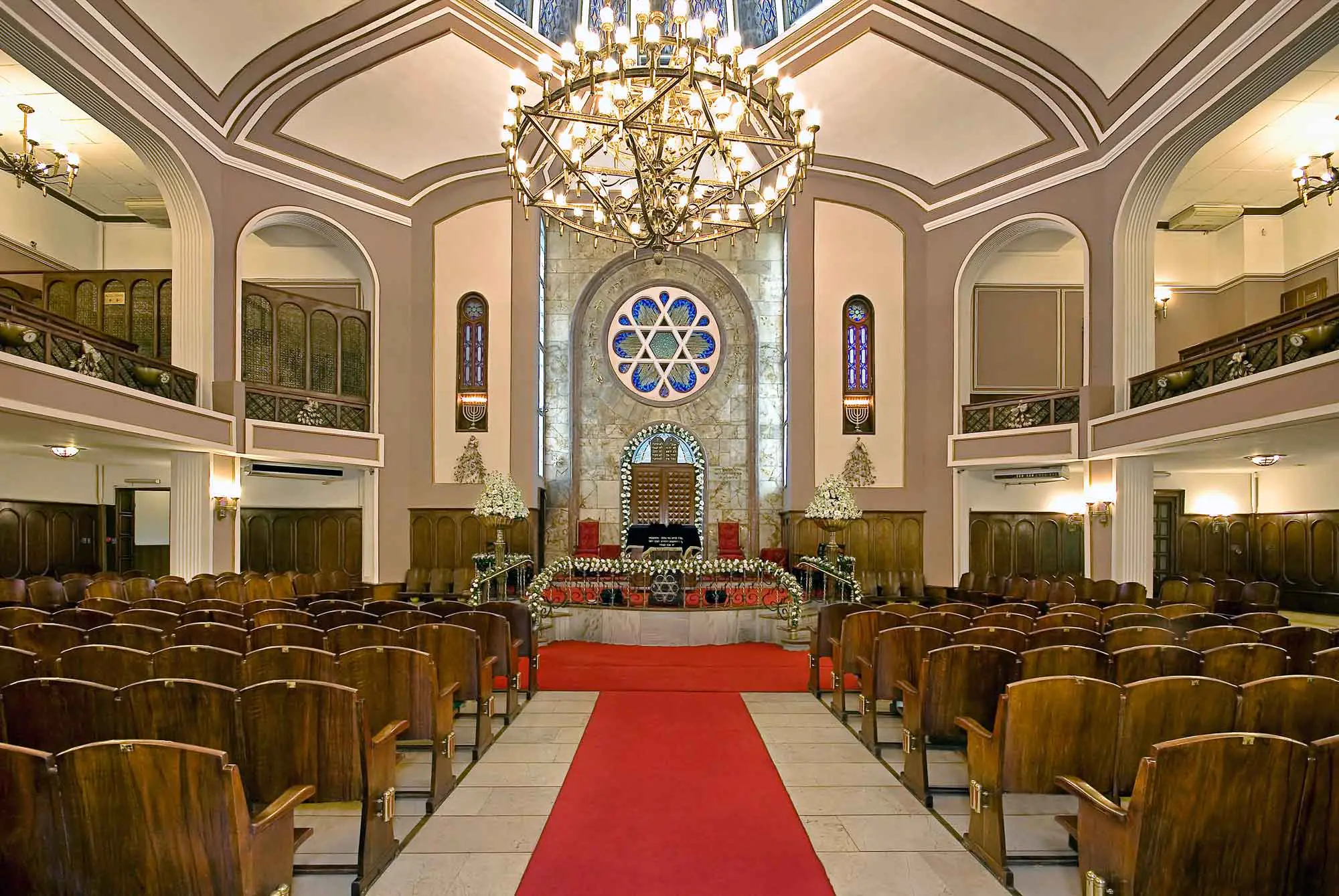
Its architects created a large central prayer hall beneath an impressive dome.
One of their greatest engineering challenges was designing the dome so that it could support the synagogue’s enormous central chandelier.
Specialist calculations were undertaken for the structure, while considerable attention was also given to the decorative elements of the interior.
The resulting space combines architectural monumentality with the functional requirements of a major synagogue.
The dome, chandelier, stained glass, women’s gallery, Ehal, and arrangement of the prayer hall together create one of the most recognizable synagogue interiors in Istanbul.
The Dome and Chandelier
The dome is one of the defining architectural elements of Neve Shalom.
During the design process, Elyo Ventura and Bernar Motola faced the difficult problem of creating a dome capable of supporting a particularly large and heavy chandelier.
Special structural calculations were therefore required for the project.
The chandelier became one of the principal visual elements of the interior, suspended dramatically above the congregation beneath the dome.
Light entering through the windows surrounding the upper sections of the prayer hall further emphasizes the height and openness of the interior.
Together, the dome and chandelier give Neve Shalom a monumental character appropriate to its role as one of the principal synagogues of Istanbul.
The Stained-Glass Windows
Another distinctive feature of Neve Shalom is its stained glass.
The designs were prepared at Istanbul’s Academy of Fine Arts, while the glass itself was imported from England.
The stained-glass windows allow colored light to enter the prayer hall and contribute considerably to the atmosphere of the interior.
Their presence also reflects the architectural ambitions behind Neve Shalom.
This was not intended merely to provide additional space for worship. The community sought to create a synagogue that would represent Jewish religious life in modern Istanbul through architecture, craftsmanship, and artistic design.
The Ehal and Prayer Hall
The Ehal HaKodesh, or Holy Ark, forms the sacred focal point of Neve Shalom Synagogue.
The Torah scrolls are kept within the Ehal and brought into the congregation during religious services for the reading of the Torah.
The prayer hall is organized around the requirements of Jewish worship, with the principal religious furnishings positioned beneath the large domed interior.
A women’s gallery overlooks the main sanctuary, reflecting the traditional organization of worship within the synagogue.
The combination of the Ehal, dome, chandelier, stained glass, galleries, and ceremonial furnishings creates an interior that is very different from the intimate atmosphere of Istanbul’s older neighborhood synagogues.
Neve Shalom was designed to function as a major communal synagogue.
That role continues to define it today.
A Center of Sephardic Jewish Life
Neve Shalom became particularly associated with Istanbul’s Sephardic Jewish community.
The Sephardic presence in the Ottoman Empire expanded dramatically following the expulsion of Jews from Spain in 1492 and Portugal in the following years. Over the centuries, Sephardic culture became one of the defining elements of Jewish life in Istanbul.
Ladino, or Judeo-Spanish, was spoken by generations of Ottoman and Turkish Jews, while Sephardic religious traditions, music, cuisine, literature, and communal customs became deeply rooted in the city.
By the time Neve Shalom opened in 1951, this community had already experienced enormous political and social transformations.
The Ottoman Empire had disappeared, the Republic of Turkey had been established, and many traditional Jewish neighborhoods were changing.
Neve Shalom represented a new center for Jewish communal life within this modern environment.
Weddings, Festivals and Community Ceremonies
Since its opening, Neve Shalom has hosted some of the most important occasions in the life of Istanbul’s Jewish community.
Religious festivals and major services have been celebrated within its sanctuary, while generations of Jewish families have gathered there for weddings, Bar and Bat Mitzvahs, funerals, and other religious ceremonies.
The synagogue has also hosted important communal events and ceremonies associated with the Chief Rabbinate.
This living function is essential to understanding Neve Shalom.
Unlike a synagogue preserved primarily as a historic monument, Neve Shalom remains closely associated with the continuing religious life of Istanbul’s Jewish community.
For visitors, this makes the synagogue especially significant.
It connects the centuries-old Jewish history of Istanbul with a community that continues to practice its faith and preserve its traditions in the city today.
The 1986 Terrorist Attack
The history of Neve Shalom also contains profound tragedy.
On September 6, 1986, terrorists entered the synagogue during Shabbat morning prayers and attacked the congregation.
Twenty-two Jewish worshippers were killed.
The massacre became one of the darkest events in the modern history of Istanbul’s Jewish community.
The attack transformed the security environment surrounding Jewish religious institutions in Turkey and left a lasting scar on the congregation.
The synagogue was subsequently repaired and reopened for worship in 1987.
The victims remain part of the collective memory of Neve Shalom and the Jewish community of Turkey.
The 2003 Istanbul Synagogue Bombings
Seventeen years later, Neve Shalom was again targeted.
On the morning of November 15, 2003, terrorists carried out simultaneous vehicle bomb attacks against Neve Shalom Synagogue and Beth Israel Synagogue in Sisli.
The attacks took place during Shabbat.
The explosions killed Jewish worshippers, synagogue security personnel, a police officer, and people who happened to be on the surrounding streets. Many others were injured.
The attacks therefore struck not only Istanbul’s Jewish community but the wider city.
Neve Shalom was damaged and subsequently underwent repairs and additional security reinforcement.
The synagogue once again reopened.
The continued use of Neve Shalom after these attacks has given the meaning of its name — Oasis of Peace — an even deeper resonance.
Remembrance and Resilience
The terrorist attacks form an unavoidable part of Neve Shalom’s history, but they do not define the synagogue.
The building has witnessed far more than tragedy.
For decades it has been a place where families have celebrated marriages, children have entered religious adulthood, congregations have welcomed Shabbat, festivals have been observed, Torah has been read, and generations have gathered in prayer.
Its survival and continued religious use therefore represent continuity rather than simply remembrance.
For the Jewish community of Istanbul, Neve Shalom remains both a sacred place and a powerful symbol of resilience.
For visitors, understanding this history is essential to approaching the synagogue respectfully. The security surrounding Neve Shalom and other Jewish institutions in Istanbul exists within a very real historical context.

The Jewish Museum of Turkey
Neve Shalom is also closely associated with the Quincentennial Foundation Museum of Turkish Jews, commonly known as the Jewish Museum of Turkey.
The museum presents the long and diverse history of Jewish life in the lands of present-day Turkey, including the experiences of Romaniote, Sephardic, and Ashkenazi communities.
Its collections explore religious traditions, everyday life, cultural heritage, community institutions, historical events, and the relationship between Jewish communities and the societies around them.
The museum provides valuable context for visitors who want to understand that Jewish history in Turkey extends far beyond individual synagogues or the arrival of Sephardic Jews from Spain.
Together, Neve Shalom and the museum provide one of the most comprehensive introductions to Jewish heritage in Istanbul.
Neve Shalom and the Synagogues of Galata
Neve Shalom should also be understood within the wider Jewish landscape of Galata.
The district has been associated with Jewish life for centuries and contains several important sites connected with different periods and communities.
The nearby Ashkenazi Synagogue represents the Central and Eastern European Jewish tradition that existed alongside Istanbul’s much larger Sephardic population.
The historic Schneidertempel, once associated with the Ashkenazi tailors of Galata, preserves another layer of the district’s Jewish past.
Other former synagogues and Jewish institutions reveal how extensive the community’s presence in this part of Istanbul once was.
Exploring these sites together makes it possible to understand Galata not simply as a popular historic neighborhood but as one of the most important centers of Jewish life in modern Istanbul.
From Balat to Galata
A Jewish heritage tour of Istanbul often reveals a fascinating geographical story.
Historic synagogues such as Ahrida and Yanbol recall the centuries when Balat was one of the great centers of Jewish life along the Golden Horn.
Neve Shalom and the Ashkenazi Synagogue illustrate the increasing importance of Galata and Beyoglu during later periods.
Other synagogues in neighborhoods such as Ortakoy, Kuzguncuk, and Sisli reveal further movements of Istanbul’s Jewish population.
The synagogues therefore tell more than the history of religion.
Together they provide a map of migration, social change, economic development, and changing patterns of urban life across several centuries.
Neve Shalom occupies a particularly important place within this story because it represents the emergence of a modern central synagogue for Istanbul’s Jewish community in the middle of the 20th century.
Neve Shalom Synagogue Today
Today, Neve Shalom remains an active synagogue and one of the principal institutions of Jewish religious life in Istanbul.
Religious services and community ceremonies continue to take place within the building.
This distinction is important for visitors.
Neve Shalom should not be approached simply as another historic attraction in Galata. It is first and foremost a functioning house of worship serving a living religious community.
Its architecture and history are certainly remarkable, but its greatest significance comes from the fact that the traditions represented within the building continue today.
Visiting Neve Shalom Synagogue
Because Neve Shalom remains an active synagogue and operates under strict security procedures, visits require advance arrangements.
Access is subject to synagogue availability, religious services, Jewish holidays, community events, and current security requirements.
Visitors may be required to provide passport information in advance as part of the access arrangements and should carry their passports on the day of the visit.
Security procedures should be respected and may affect the timing and availability of visits.
For these reasons, Neve Shalom should not be treated as a spontaneous sightseeing stop.
Visitors should also dress respectfully and remember that they are entering one of the most important functioning Jewish religious institutions in Turkey.
Discover Jewish Galata with a Private Guide
Neve Shalom becomes considerably more meaningful when explored within the wider history of Jewish Galata and Jewish Istanbul.
A private Jewish heritage tour can connect the synagogue with the Jewish Museum of Turkey, Ashkenazi heritage in Galata, the historic Jewish neighborhoods along the Golden Horn, and other synagogues representing different periods of Istanbul’s Jewish history.
At Eskinazi Tours & Events, our Jewish heritage tours are individually designed according to your interests, available time, and the synagogues accessible on the day of your visit. Our team coordinates the necessary synagogue arrangements in advance whenever possible, while your licensed private guide provides the historical and cultural context needed to understand the remarkable story of Jewish life in Istanbul.
Whether your interests are Sephardic history, synagogue architecture, Ottoman Jewish life, modern Jewish history, or your own family’s connection with Turkey, we can create a private itinerary around the aspects of Jewish Istanbul that are most meaningful to you.