

Discover One of the Historic Synagogues of Balat
Hidden among the historic streets of Balat, the Yanbol Synagogue is one of the most remarkable surviving monuments of Jewish life in Istanbul. Its history is closely connected with Jews who came to the Ottoman capital from the town of Yanbol, present-day Yambol in Bulgaria, and established their community in Balat.
Unlike many monuments created primarily for rulers or empires, Yanbol tells the story of a community. Its name preserves the memory of the place its founders had left behind, while its architecture, religious furnishings, inscriptions, and beautifully decorated wooden ceiling reflect centuries of Jewish worship in one of Istanbul’s oldest Jewish neighborhoods.
Together with the nearby Ahrida Synagogue, Yanbol is an important surviving witness to the extraordinary Jewish history of Balat and to the communities that arrived in Constantinople from different parts of the Balkans during the Ottoman period.
The Jewish Community of Balat
Balat has been associated with Jewish life for centuries. Situated along the Golden Horn, the neighborhood became home to Jewish communities of different origins and traditions, including Jews whose presence in Constantinople predated the great Sephardic migrations of the late 15th century.
Following the Ottoman conquest of Constantinople in 1453, the population of the new capital expanded considerably. Jews from different parts of the Ottoman territories settled in the city, while further migrations transformed its Jewish population during the following centuries.
Balat developed into one of Istanbul’s most important Jewish neighborhoods. Its narrow streets once contained numerous synagogues, schools, shops, homes, religious institutions, and communal buildings.
Many congregations maintained connections with the towns and regions from which their members had originated. This history can still be seen in the names of several historic synagogues associated with places in the Balkans.
Yanbol Synagogue is one of the most important surviving examples of this tradition.
From Yanbol to Constantinople
Yanbol, today known internationally as Yambol, is a city in present-day Bulgaria that was incorporated into the Ottoman Empire during the late 14th century.
A Jewish community existed there during the Ottoman period, and Jews originating from Yanbol eventually settled in Constantinople. In Balat they established a congregation that continued to identify itself with the town from which its members had come.
The synagogue they created became known as the Yanbol Synagogue.
This practice of naming congregations after their places of origin provides a fascinating insight into the organization of Jewish life in the Ottoman capital. Communities arriving from different cities could preserve particular traditions and memories even after establishing new lives in Constantinople.
Over generations, these communities became part of the wider Jewish population of Istanbul, but the names of their synagogues continued to preserve the geography of earlier migrations.
The Origins of Yanbol Synagogue
The precise date when the first Yanbol Synagogue was established is difficult to determine with certainty.
Historical references indicate that a synagogue associated with the Yanbol community existed in Balat centuries ago, making it one of Istanbul’s historic Jewish religious institutions. The building underwent repeated repairs and reconstruction as fires, earthquakes, deterioration, and the passage of time affected the neighborhood.
The structure visible today therefore should not be understood as a completely unchanged building from the 15th century. Like many historic religious monuments in Istanbul, it developed through successive periods of rebuilding and restoration.
Evidence associated with the synagogue points to significant repairs during the Ottoman period, including work in the 18th and 19th centuries.
This layered history makes Yanbol particularly interesting. Rather than representing a single moment in time, the synagogue reflects centuries of continuous communal memory and adaptation.
A Synagogue Shaped by Centuries of History
Istanbul has experienced countless fires and earthquakes throughout its history, and the predominantly wooden neighborhoods surrounding the Golden Horn were especially vulnerable to destruction.
Yanbol Synagogue was affected by these changing conditions and underwent several major repairs and renovations.
Historical inscriptions and records indicate important restoration campaigns at different periods, including work in 1709, 1865, and 1895. These interventions helped preserve the synagogue while inevitably altering parts of the structure.
The result is a building in which different periods of Ottoman Jewish history can be encountered within the same sacred space.
Its survival is particularly significant when considered alongside the many synagogues that once existed throughout Balat but disappeared as the neighborhood’s Jewish population declined and Istanbul’s urban landscape changed.
Architecture of Yanbol Synagogue
Yanbol Synagogue is relatively discreet from the surrounding streets, reflecting a characteristic often encountered in historic Jewish religious buildings in Istanbul.
Beyond its entrance lies a religious complex organized around the synagogue and its courtyard.
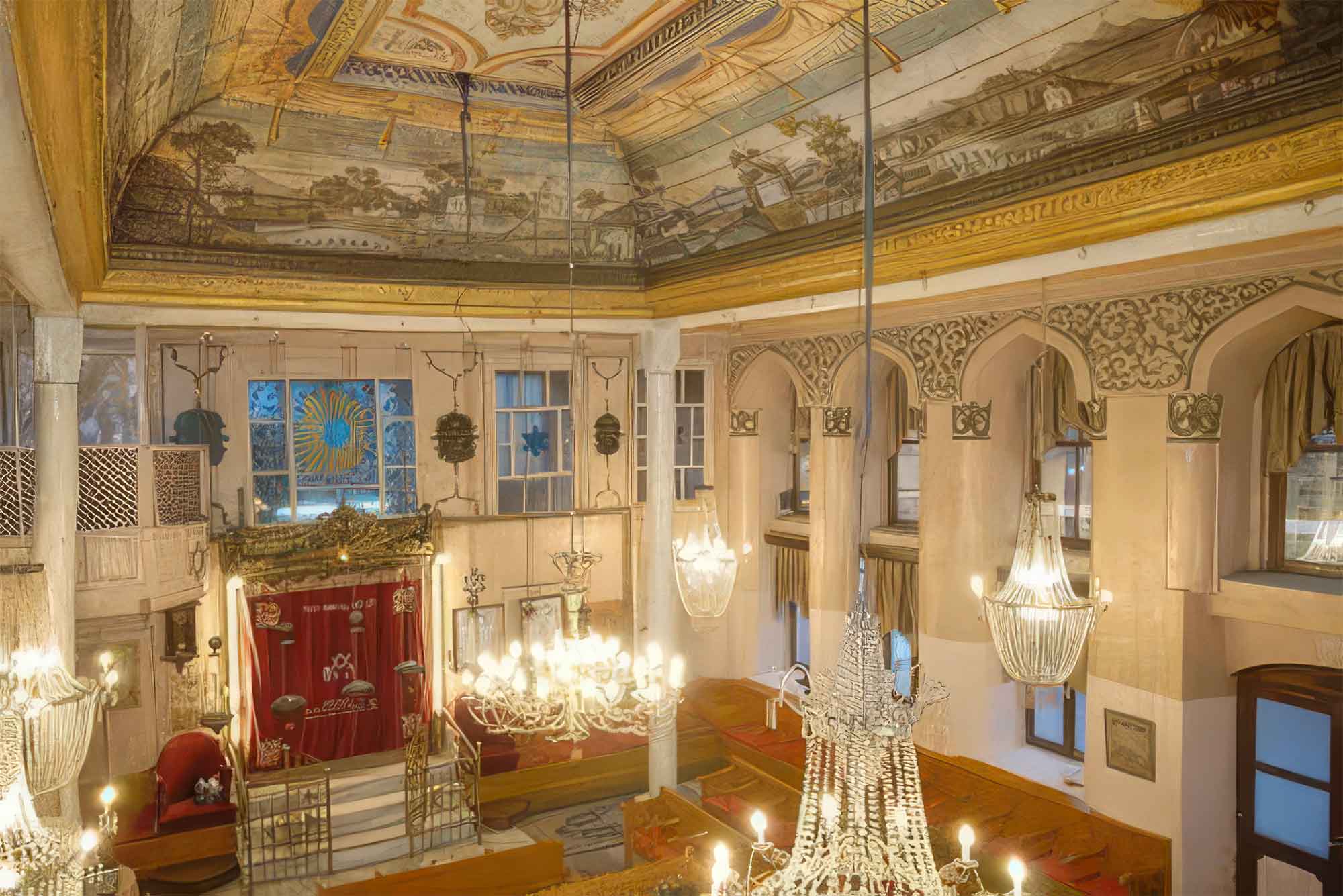
The main structure is built of masonry, but one of its most remarkable architectural features is found above the prayer hall: its historic wooden ceiling.
The synagogue is especially known for this ceiling and its painted decoration. Rather than relying solely on geometric or religious motifs, parts of the decoration incorporate representations inspired by nature, creating an unusual and atmospheric interior.
Wooden architectural elements, galleries, religious furnishings, painted surfaces, and the proportions of the prayer hall combine to give Yanbol a character quite different from Istanbul’s larger and more modern synagogues.
Its importance lies not in monumental scale but in the survival of an intimate religious environment shaped by generations of worshippers.
The Painted Wooden Ceiling
One of the most distinctive features of Yanbol Synagogue is its painted wooden ceiling.
The ceiling has long been regarded as one of the building’s defining architectural elements. Its painted decoration includes natural and landscape-inspired imagery that distinguishes the synagogue from many other historic Jewish places of worship in Istanbul.
The use of painted decoration provides an intriguing glimpse into the artistic environment in which Ottoman Jewish communities lived. Synagogues did not develop in complete isolation from the architecture and decorative traditions surrounding them. Craftsmen, materials, techniques, and artistic influences circulated throughout the Ottoman capital.
At Yanbol, the result is an interior in which religious function and local artistic traditions come together.
The preservation of this ceiling became particularly important as the building aged, and its conservation has been a major element of recent efforts to protect the synagogue.
The Ehal and Religious Interior
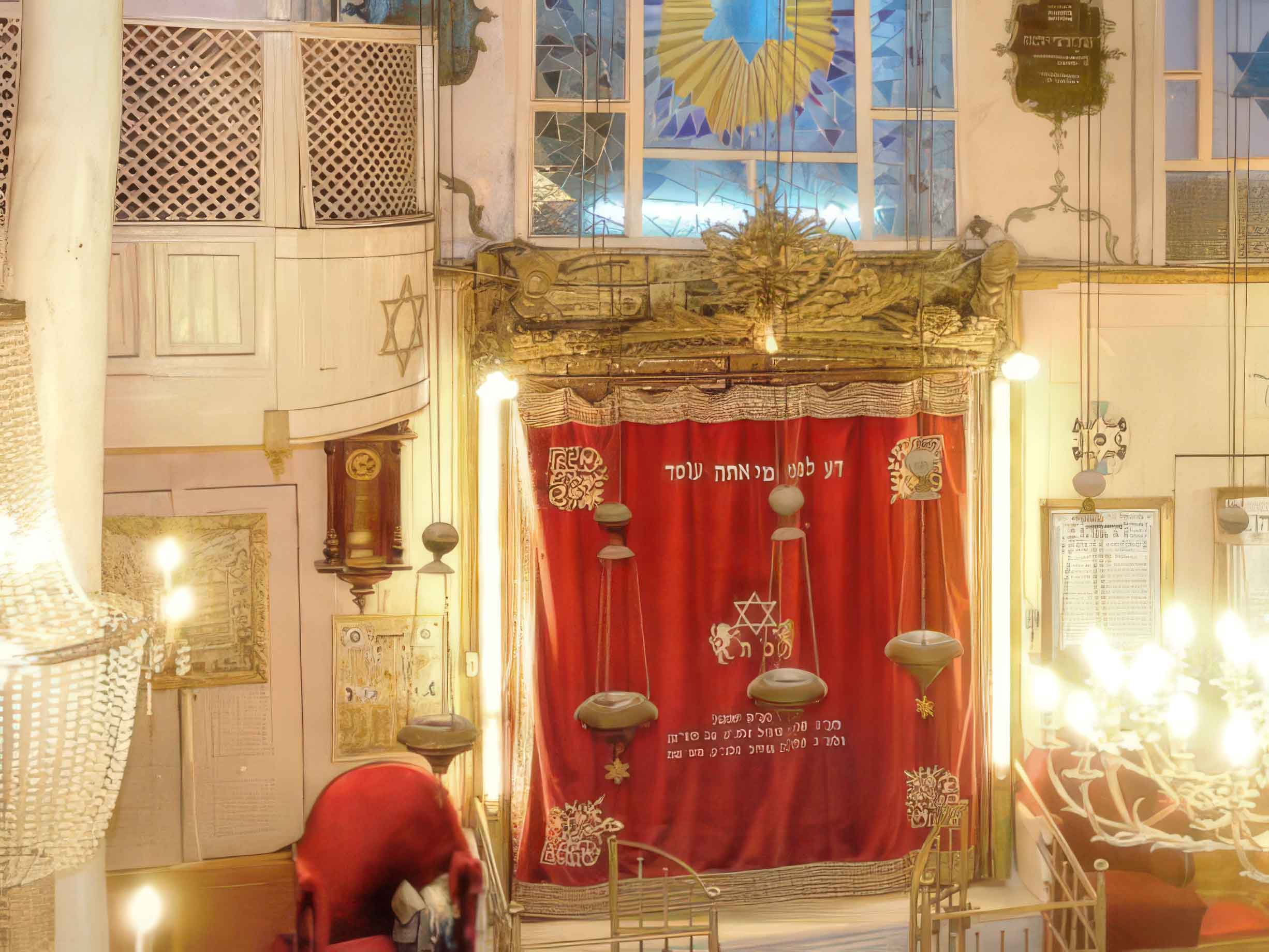
At the heart of the synagogue stands the Ehal HaKodesh, or Holy Ark, where the Torah scrolls are kept.
The Ehal is one of the most visually significant features of the interior. Its historic wooden doors include delicate mother-of-pearl inlay, demonstrating the craftsmanship incorporated into the synagogue’s sacred furnishings.
The Torah ark is approached as the principal sacred focus of the prayer hall, while the arrangement of the interior reflects the requirements of traditional Jewish worship.
The Tevah, from which the Torah is read, is another central element of synagogue life. Together, the Ehal and Tevah define the religious organization of the space and help visitors understand that Yanbol is not simply an architectural monument but a house of worship created for prayer, Torah reading, and community gatherings.
The Women’s Section
Yanbol Synagogue also contains an Azara, the traditional women’s section of the synagogue.
The gallery is integrated into the historic wooden structure of the interior and overlooks the principal prayer space. Its construction provides another glimpse into the organization of religious life within Istanbul’s traditional synagogues.
Elements such as the Azara, Ehal, Tevah, ceiling, inscriptions, and religious furnishings together reveal how generations of worshippers experienced the building.
They also make Yanbol particularly valuable for understanding the architecture of the smaller neighborhood synagogues that once existed throughout Jewish Istanbul.
Yanbol and the Synagogues of Balat
Yanbol was once only one of numerous synagogues serving the Jewish population of Balat.
Different congregations established places of worship associated with the communities from which they had originated. Historical accounts preserve the names of several synagogues connected with places in the Balkans and the eastern Mediterranean.
Over time, many of these congregations disappeared as communities merged, buildings were damaged or abandoned, and Jewish families gradually moved from Balat to other districts of Istanbul.
By the 20th century, neighborhoods such as Galata, Pera, Sisli, Ortakoy, and the districts on the Asian side became increasingly important centers of Jewish residential life.
Yanbol and Ahrida survived these demographic transformations and today provide an extraordinary connection with a period when Balat was one of the principal centers of Jewish life in Istanbul.
Jewish Life in Old Balat
Understanding Yanbol Synagogue also requires imagining the neighborhood that once surrounded it.
Balat was not simply a district containing several synagogues. It was a living Jewish neighborhood where religious, commercial, educational, and family life unfolded in the surrounding streets.
Jewish shopkeepers and craftsmen operated businesses in the neighborhood, children attended local schools and religious classes, families prepared for Shabbat and festivals, and synagogues filled with worshippers on important religious occasions.
Weddings, Bar Mitzvahs, funerals, and communal gatherings formed part of the rhythm of neighborhood life.
Ahrida and Yanbol were particularly important institutions within this environment.
The Jewish population of Balat eventually declined considerably as families moved to other parts of Istanbul or emigrated abroad. Yet the surviving synagogues preserve a tangible connection with the generations who once filled these streets.
The Restoration of Yanbol Synagogue
Preserving a centuries-old building requires continuous attention, particularly when historic timber, painted decoration, and religious furnishings are involved.
Yanbol Synagogue has undergone numerous repairs during its long history, and a major conservation effort was undertaken again in recent years as parts of the building required significant attention.
The project included work on the historic structure and the preservation of important interior features, particularly the synagogue’s remarkable ceiling and religious furnishings.
The restoration also revealed and renewed areas associated with the synagogue complex, allowing the building to serve the community more effectively while protecting its historic character.
Following this extensive work, the restored synagogue was formally reopened in October 2025.
Its restoration represents more than the conservation of an old building. It preserves an important part of the cultural memory of Balat and ensures that a synagogue associated with centuries of Jewish history can continue to be experienced by future generations.
Yanbol Synagogue Today
Today, Yanbol Synagogue remains an important part of Istanbul’s Jewish religious and cultural heritage.
Its significance comes not only from its age but also from the remarkable continuity represented by the building. The name Yanbol still recalls the community that established itself in Balat centuries ago, while the synagogue continues to preserve religious objects, architectural elements, inscriptions, and memories accumulated across generations.
The synagogue is also a reminder of how dramatically Istanbul’s Jewish geography has changed.
The surrounding streets no longer contain the large Jewish population that once characterized Balat, yet Yanbol remains within the neighborhood as a surviving witness to that history.
Together with Ahrida Synagogue, it offers one of the most meaningful opportunities to explore the Jewish heritage of the Golden Horn.
Visiting Yanbol Synagogue
Yanbol Synagogue is an active Jewish religious site rather than a conventional tourist attraction.
Visits therefore require advance arrangements and are subject to the synagogue’s schedule, religious holidays, community activities, services, and current security procedures.
Visitors may be required to provide passport information in advance as part of the necessary access arrangements.
Because availability can change, visits should be organized before the day of the tour. Access cannot always be guaranteed, particularly during Jewish holidays, religious services, or community events.
Visitors should dress respectfully and remember that they are entering a functioning place of worship with considerable historical and religious significance.
Discover Jewish Balat with a Private Guide
Visiting Yanbol Synagogue becomes especially meaningful when the building is explored within the wider history of Jewish Balat.
The nearby Ahrida Synagogue provides another extraordinary connection with the historic Jewish communities of the neighborhood, while the surrounding streets preserve traces of the homes, businesses, synagogues, and institutions that once made Balat one of the centers of Jewish life in Istanbul.
A private Jewish heritage tour can place these monuments within the broader story of Jewish Constantinople and Istanbul, including the Romaniote communities, migrations from the Balkans, the arrival of Sephardic Jews following the expulsions from the Iberian Peninsula, Jewish life under the Ottoman Empire, and the changing geography of Istanbul’s Jewish community.
At Eskinazi Tours & Events, our Jewish heritage tours are individually designed according to your interests, available time, and the synagogues accessible on the day of your visit. Our team coordinates the necessary synagogue arrangements in advance whenever possible, while your licensed private guide provides the historical and cultural context needed to understand the remarkable Jewish heritage of Balat and Istanbul.
Whether your interests are Jewish history, synagogue architecture, Sephardic heritage, Ottoman history, or your own family’s connection with Turkey, we can create a private itinerary around the aspects of Jewish Istanbul that are most meaningful to you.