

Discover the Historic Jewish Heritage of Kuzguncuk
Located in the charming Bosphorus neighborhood of Kuzguncuk on Istanbul’s Asian side, Beth Yaakov Synagogue is one of the most important surviving monuments of Jewish life along the Bosphorus.
The present synagogue dates to 1878, although documentary evidence indicates that a Jewish place of worship existed on the site earlier. An Ottoman decree issued in 1862 authorized repairs to an existing synagogue, suggesting that the religious history of the site predates the present building.
Traditionally known in Judeo-Spanish as Kal de Abasho — the “Lower Synagogue” — Beth Yaakov served a substantial Sephardic Jewish community that once made Kuzguncuk one of Istanbul’s most distinctive Jewish neighborhoods.
Today, the Jewish population of Kuzguncuk is much smaller than it was generations ago, but Beth Yaakov remains an active synagogue. Its survival preserves an important connection with the families who once filled the streets of this historic Bosphorus village.
The Jewish History of Kuzguncuk
The history of Beth Yaakov cannot be separated from the remarkable Jewish history of Kuzguncuk.
Situated on the Asian shore of the Bosphorus between Uskudar and Beylerbeyi, Kuzguncuk developed into one of Istanbul’s most multicultural neighborhoods.
Jewish settlement in the area extends back several centuries. One of the earliest physical indications of an established Jewish presence is a gravestone dating from 1562.
The community expanded considerably during the Ottoman period. Some Jewish families moved to Kuzguncuk from older Jewish districts of Istanbul, while others were attracted by the neighborhood’s location along the Bosphorus.
By the 18th and 19th centuries, Jewish residents formed an important part of Kuzguncuk’s population.
The neighborhood eventually contained synagogues, Jewish schools, businesses, homes, and communal institutions, while the large Jewish cemetery at nearby Nakkastepe became one of the most important Jewish burial grounds in Istanbul.
Kuzguncuk and Sephardic Jewish Life
Kuzguncuk became particularly associated with Istanbul’s Sephardic Jewish community.
Following the expulsions from Spain in 1492 and Portugal in the following years, Sephardic Jews settled throughout the Ottoman Empire. Over generations, their descendants established communities in numerous neighborhoods of Constantinople.
The Jewish geography of the city gradually changed.
Older districts such as Balat and Haskoy remained important, but Jewish families also established themselves along the Bosphorus in neighborhoods such as Kuzguncuk and Ortakoy.
Kuzguncuk became a particularly attractive residential area. Its waterfront location, village atmosphere, commercial life, and proximity to Uskudar made it an important Jewish center on the Asian side.
For generations, Ladino, or Judeo-Spanish, could be heard in the streets alongside Turkish, Greek, Armenian, and other languages spoken by the neighborhood’s inhabitants.
Beth Yaakov stood at the heart of this community.
The Origins of Beth Yaakov Synagogue
The present Beth Yaakov Synagogue is generally dated to 1878.
However, the history of a synagogue on the site appears to be older.
An Ottoman document dated July 27, 1862 granted permission for repairs to a synagogue already standing in Kuzguncuk. This indicates that a Jewish place of worship existed there before the construction of the present building.
The 1878 date therefore most likely refers to the construction or substantial rebuilding of the synagogue in the form from which the present structure developed.
This layered history is common among Istanbul’s historic synagogues.
Fires, earthquakes, deterioration, population growth, and changing communal needs frequently required religious buildings to be repaired or reconstructed. As a result, the history of a congregation can be considerably older than the surviving architecture.
Kal de Abasho: The Lower Synagogue
Beth Yaakov was traditionally known among the Judeo-Spanish-speaking Jews of Kuzguncuk as Kal de Abasho.
The name means “Lower Synagogue.”
This distinguished it from another synagogue located farther uphill in Kuzguncuk, traditionally known as Kal de Ariva — the “Upper Synagogue.”
Kal de Ariva was also known as the Virane Synagogue and later became known as Beth Nissim Synagogue.
These traditional Ladino names reveal something important about everyday Jewish life in Kuzguncuk.
For local residents, the synagogues were not simply formal religious institutions. They were neighborhood landmarks embedded in the geography and daily life of the community.
One went uphill to the upper synagogue or downhill toward the lower synagogue.
The terminology survived in communal memory even as the Jewish population of the neighborhood gradually declined.
The Synagogues of Kuzguncuk
Kuzguncuk historically contained several Jewish places of worship.
Beth Yaakov and the synagogue later known as Beth Nissim are the best-known surviving examples, while historical records also mention other synagogues that no longer exist.
The presence of multiple synagogues within a relatively small neighborhood demonstrates the size and vitality of the former Jewish population.
Synagogues served more than a strictly religious function. They were places where neighbors met, children learned religious traditions, communal affairs were discussed, families celebrated important occasions, and generations maintained connections with one another.
On Shabbat and major Jewish festivals, the streets surrounding the synagogues would have been filled with local families making their way to prayer.
Beth Yaakov was one of the principal institutions within this world.
Architecture of Beth Yaakov Synagogue
Beth Yaakov differs in character from the monumental Neve Shalom Synagogue in Galata and from the centuries-old synagogues of Balat.
Its architecture reflects its original function as a neighborhood synagogue serving a close-knit Bosphorus community.
The building is constructed primarily of brick and contains a traditional synagogue interior organized around the requirements of Sephardic Jewish worship.
The exterior is relatively restrained, while the interior contains considerably richer decoration.
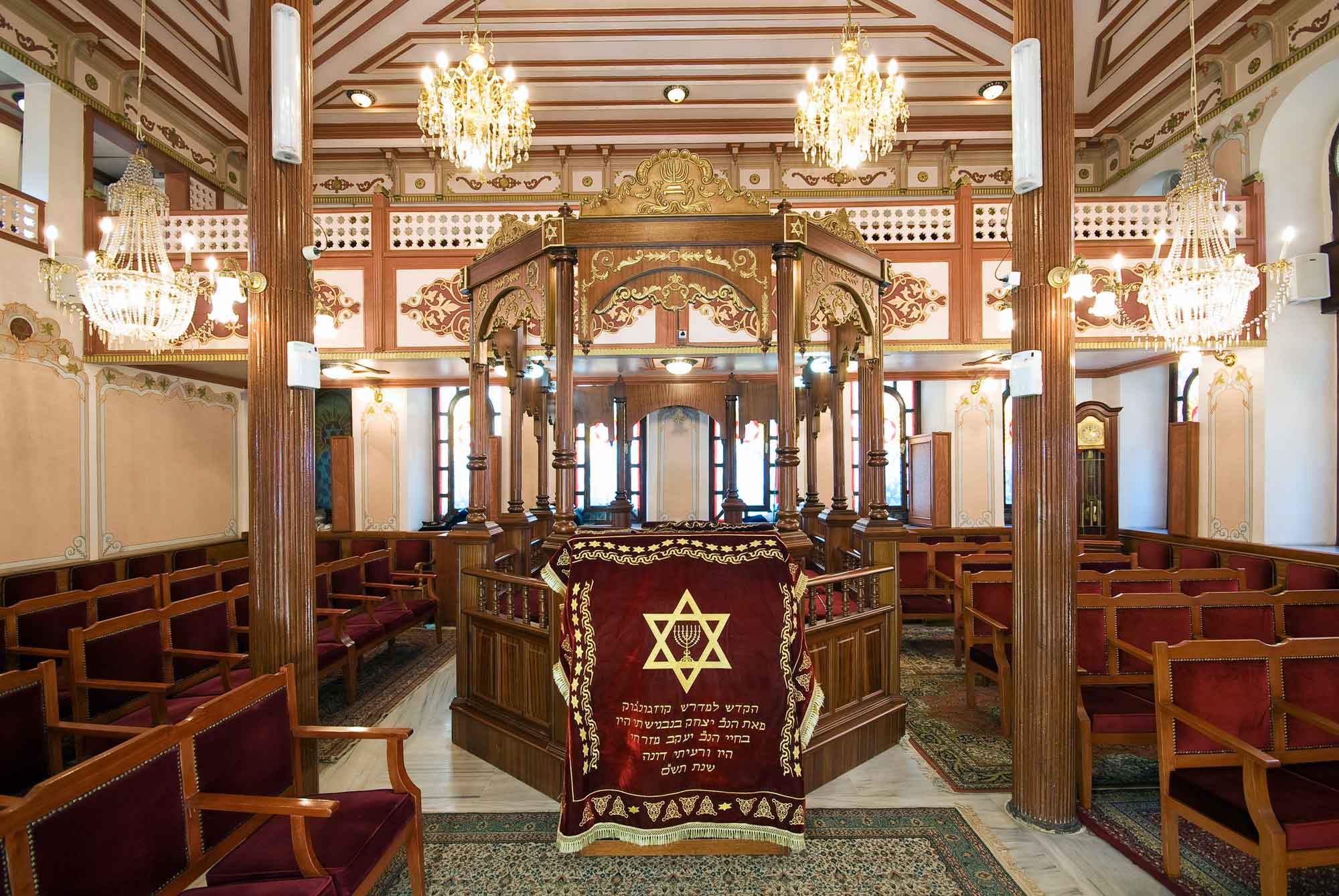
Woodwork, religious furnishings, decorative painting, and the organization of the prayer hall create an intimate atmosphere that reflects the building’s communal character.
Rather than overwhelming visitors through scale, Beth Yaakov derives much of its appeal from the relationship between its architecture and the history of the families who worshipped there.
Inside Beth Yaakov Synagogue
The interior of Beth Yaakov preserves several features characteristic of a traditional Sephardic synagogue.
The Ehal HaKodesh, or Holy Ark, contains the Torah scrolls and forms the sacred focal point of the sanctuary.
The Tevah provides the platform from which the Torah is read before the congregation.
The prayer hall is complemented by the women’s section, while extensive wooden details and decorative elements contribute to the distinctive character of the interior.
One of the most memorable aspects of Beth Yaakov is the painted decoration found above the sanctuary.
These paintings distinguish the synagogue from many other Jewish religious buildings in Istanbul and give its interior a particularly recognizable character.
Paintings of the Holy Land
Among the most interesting artistic features of Beth Yaakov are paintings depicting sacred places and landscapes associated with the Land of Israel.
These images appear within the upper portions of the synagogue interior and introduce an unusual visual element into the prayer space.
Depictions of Jerusalem and other sacred locations have a long history within Jewish art. Such images could express spiritual attachment to the Holy Land while allowing communities living far away to visualize places central to Jewish religious memory.
At Beth Yaakov, the paintings add another layer to the synagogue’s religious and artistic identity.
They also distinguish its interior from the architectural character of Istanbul’s other historic synagogues.
The Ehal HaKodesh and Woodwork
The Ehal HaKodesh is among the most important religious and artistic elements within Beth Yaakov.
As the place where the Torah scrolls are kept, the Ehal forms the principal sacred focus of the synagogue.
The synagogue is also notable for its historic woodwork.
Carved wooden elements and furnishings contribute considerably to the warmth of the interior and reflect the craftsmanship incorporated into a neighborhood synagogue that served generations of Kuzguncuk families.
These features remind visitors that synagogue architecture is not simply about the building itself.
The Ehal, Tevah, galleries, paintings, inscriptions, lamps, textiles, and wooden furnishings all formed part of the religious environment experienced by the congregation.

Shabbat in Old Kuzguncuk
Historical memories of Kuzguncuk provide a fascinating picture of a neighborhood in which Jewish religious life was once deeply woven into everyday routines.
Local synagogues served active congregations, and several prayer services could be held to accommodate worshippers.
Rabbis, Hazzanim, religious teachers, and other community figures were familiar members of neighborhood life.
Shabbat transformed the rhythm of the community.
Families gathered for prayer, businesses closed according to religious observance, and the synagogues became centers of social as well as spiritual life.
Major festivals such as Rosh Hashanah, Yom Kippur, Passover, Sukkot, and Purim brought additional activity to the neighborhood.
Beth Yaakov preserves the memory of this world even though the demographic character of Kuzguncuk has changed dramatically.
A Jewish Community Along the Bosphorus
The Jewish history of Kuzguncuk forms part of a larger story of Jewish settlement along the Bosphorus.
Across the water, Etz Ahayim Synagogue in Ortakoy served another important Sephardic community.
Farther south and west, Jewish communities were concentrated in districts such as Haskoy, Balat, and Galata.
These neighborhoods reveal how Jewish Istanbul evolved geographically over several centuries.
Families moved according to economic opportunities, fires, changing transportation, new residential preferences, and the expansion of the city.
Kuzguncuk occupies an important place in this story because it became one of the principal historic Jewish settlements on Istanbul’s Asian side.
Nakkastepe Jewish Cemetery
Another important witness to the Jewish history of Kuzguncuk is the Nakkastepe Jewish Cemetery.
Located on the hillside above the neighborhood, the cemetery contains graves representing centuries of Jewish life in Istanbul.
Some of its oldest surviving tombstones date to the 16th century.
Inscriptions in Hebrew and Judeo-Spanish provide valuable evidence about the individuals and families who formed the Jewish community of the area.
Jewish cemeteries are particularly important historical sources because they preserve names, family relationships, religious titles, languages, symbols, and dates that may not survive elsewhere.
Nakkastepe therefore complements Beth Yaakov in telling the story of Jewish Kuzguncuk.
The synagogue represents the religious life of the community, while the cemetery preserves the memory of generations who lived and died there.
Kuzguncuk’s Multicultural Heritage
Kuzguncuk is today celebrated as one of Istanbul’s most characteristic examples of a historically multicultural neighborhood.
Jewish, Greek Orthodox, Armenian Christian, and Muslim communities all established religious institutions within a remarkably small area.
Synagogues stand close to churches and mosques, creating an urban landscape that reflects the complex social history of Ottoman Istanbul.
Beth Yaakov is an essential part of this heritage.
The neighborhood should not be romanticized as a place entirely without social tensions or historical difficulties, but its surviving religious architecture demonstrates that communities with different faiths and traditions lived in close proximity for generations.
Walking through Kuzguncuk today, visitors can still encounter this history in its synagogues, churches, mosques, cemetery, traditional houses, and narrow streets leading toward the Bosphorus.
The Changing Jewish Population of Kuzguncuk
During the 20th century, the Jewish population of Kuzguncuk declined considerably.
Families gradually moved to other parts of Istanbul, particularly as the city expanded and newer residential districts became more attractive.
Others emigrated from Turkey.
The neighborhood that had once supported a substantial Jewish population therefore changed dramatically.
Yet former residents and their descendants maintained strong emotional connections with Kuzguncuk.
For some families, returning to Beth Yaakov for Shabbat or special occasions became a way of maintaining their connection with the neighborhood in which their parents and grandparents had lived.
This continuing relationship has played an important role in keeping the synagogue alive despite the disappearance of the large congregation that originally surrounded it.
Beth Yaakov Synagogue Today
Today, Beth Yaakov remains an active synagogue and an important part of Istanbul’s Jewish heritage.
Although only a small Jewish population remains in Kuzguncuk itself, worshippers whose families originated in the neighborhood continue to maintain their connection with the synagogue.
Services are held particularly on Shabbat and special religious occasions, depending on the congregation and current arrangements.
Its continued religious use gives Beth Yaakov a significance beyond architecture.
The synagogue preserves a living connection between contemporary Jewish Istanbul and the historic Sephardic community that once made Kuzguncuk one of the city’s most important Jewish neighborhoods.
Visiting Beth Yaakov Synagogue
Because Beth Yaakov remains an active Jewish religious institution, visits require advance arrangements.
Access is subject to synagogue availability, Shabbat services, Jewish holidays, community activities, and current security procedures.
Visitors may be required to provide passport information in advance as part of the necessary access arrangements.
Availability can change, and visits cannot always be guaranteed. For this reason, Beth Yaakov should not be treated as a spontaneous sightseeing stop.
Visitors should dress respectfully and remember that they are entering a functioning house of worship.
Discover Jewish Kuzguncuk with a Private Guide
Beth Yaakov Synagogue becomes particularly meaningful when explored within the wider history of Jewish Kuzguncuk and Jewish Istanbul.
The neighborhood provides an opportunity to discover a different side of Istanbul’s Jewish heritage from the historic synagogues of Balat or the Jewish institutions of Galata.
Its streets reveal the history of a Sephardic community that established itself along the Asian shore of the Bosphorus and lived alongside Greek Orthodox, Armenian, and Muslim neighbors for generations.
A Jewish heritage itinerary can connect Beth Yaakov with the Nakkastepe Jewish Cemetery, the multicultural landmarks of Kuzguncuk, and Etz Ahayim Synagogue in Ortakoy across the Bosphorus.
Together with the synagogues of Balat and Galata, these sites reveal how the geography of Jewish Istanbul developed and changed across several centuries.
At Eskinazi Tours & Events, our Jewish heritage tours are individually designed according to your interests, available time, and the synagogues accessible on the day of your visit. Our team coordinates the necessary synagogue arrangements in advance whenever possible, while your licensed private guide provides the historical and cultural context needed to understand the remarkable Jewish heritage of Kuzguncuk and Istanbul.
Whether your interests are Sephardic history, synagogue architecture, Ottoman Jewish life, the multicultural neighborhoods of Istanbul, or your own family’s connection with Turkey, we can create a private itinerary around the aspects of Jewish Istanbul that are most meaningful to you.